
Showing posts with label Ladies. Show all posts
Showing posts with label Ladies. Show all posts
Wednesday, February 24, 2016

Sunday, February 7, 2016
Excellent Models for Useful Garments
1913 08 page 12


Ladies’ Combination

Corset-cover
and short petticoat are combined in this design, No. 6310. Both open in front, and are joined together
at the waistline. The corset-cover is
plain, and will make no wrinkles to show through the outer garments. The neck is low, and there are no sleeves of
any kind. The petticoat fits snugly at
all points, and has just fulness enough at the lower edge for the comfort of
the wearer.
These
garments are now made things of beauty by a clever selection of materials. Crepe de Chine in the lighter qualities is
the favorite fabric, and after this a very fine and sheer batiste or
handkerchief-cambric, with insertions of Valenciennes lace or of Cluny. Colored ribbons are run through beadings,
and the fashionable woman chooses these to match or at least to harmonize with
the tones of her outer costume.
The
pattern, No. 6310, is cut in sizes from 34 to 42 inches bust measure. To make the combination in the medium size
will require 1 5/8 yards of 45-inch material, 3 7/8 yards of insertion, 3 1/2
yards of beading, 4 7/8 yards of ribbon, 2 yards of wide edging, and 5 1/4
yards of narrow edging. Price of
pattern, 10 cents.
Ladies’ Work-Apron and Cap

The
woman who wears this costume, No. 6300, when working, will certainly look as
charming as in any other style. The
apron has a plain blouse, slightly full at the waistline. The closing is in the back. The neck is cut out in a small round outline,
and the sleeves have a suspicion of fulness at the shoulder where they are
inserted. They end just below the
elbow. The skirt-portion of the apron
has a wee bit of fulness at the belt, and is attached to the blouse beneath a
belt. There are two patch-pockets on the
sides of the front.
This
apron may be worn over the dress, or it may replace it, as it resembles a dress
as much as it does any apron. The most
appropriate materials are gingham, cambric, calico, and the like, and colored
wash-braids may be used as trimming, binding all free edges, and forming the
belt.
The
apron-pattern, No. 6300, is cut in sizes from 34 to 42 inches bust
measure. To make the apron in the medium
size will require 4 5/8 yards of 36-inch material. Price of pattern, 10 cents.
Ladies’ Maternity-Gown

This
gown, No. 6289, offers great comfort to the prospective mother, and at the same
time will preserve her appearance to the last.
It is made with a body lining, which should be of something good and
heavy, such, for instance as unbleached muslin, or sateen. The fronts and the darts must be boned and
then the edges can be laced, instead of being stitched together, and eased as
desired from time to time.
The
outer portion of the garment is very pretty, with a shaped Empire yoke, cut
down low in front and finished with an ornamental collar. The lower portion of the gown is arranged in
two box plaits in front, and these have plenty of give to them, and can be
readjusted as needed. In the back there
is an underturned box plait; and this, also, is large enough to give plenty of
plan in the material.
These
gowns can be made of all wash-materials, and cotton crepe is among the
best. Figured sateen is also good, and
of course the figured and plain Japanese silks and satins, and the various soft
crepe fabrics are also desirable.
The
gown-pattern, No. 6289, is cut in sizes from 34 to 42 inches bust measure. To make the garment in the medium size will
require 6 3/8 yards of 36-nch material, 5/8 of a yard of 22-inch trimming for
collar and sleeves, and 1 1/8 yards of 36-inch lining. Width of lower edge, 3 1/8 yards. Price of pattern, 10 cents.
Wednesday, February 3, 2016
The Newest Styles in Ladies’ Costumes
1903 08 09


Ladies’ Toilette
By
combining two designs in this costume, No. 6308 and No. 6309, we have a result
which is extremely pleasing. The blouse
is one of the soft, draped models. The
shoulder-seams come very far forward, and the fronts of the blouse are gathered
along this line, or they may be plaited, if preferred. This gives a little fulness to the waist. In closing one side is drawn over the other
iin surplice-style, and the edges are trimmed with a wide frill. There is a large collar at the neck, and this
is round in shape in the back, ending just below the shoulder-seam in front.
The
new large armhole is used, and the sleeve is adjusted to this without any
fulness at the shoulder. The
three-quarter-length sleeve is generally used, but the pattern also provides a
full-length sleeve, which is gathered into a deep cuff at the wrist.
The
skirt of this costume has three gores.
It is closed at the left side of the front, where a bit of graceful
drapery is arranged at about knee-depth, and is held in place by a strap.
The
material selected for this dress should be soft. Ratine, which is to be had in many different
weights and thicknesses is appropriate, and all the cotton crepe and cotton
voile weaves, as well as the handsomer crepe de Chine and brocaded silk.
The
waist-pattern, No. 6308, is cut in sizes from 34 to 42 inches bust
measure. To make the waist in the medium
size will require 2 1/2 yards of 36-inch material. Price of pattern, 10 cents.
The
skirt-pattern, No. 6309, is cut in sizes from 22 to 30 inches waist
measure. To make the skirt in the medium
size will require 2 5/8 yards of 36-inch material. Width of lower edge is 1 3/4 yards. Price of pattern, 10 cents.
Ladies’ Dress
This
is one of the loveliest of the one-piece dresses, No. 6312. It is simplicity itself, consisting of a plain
blouse, cut out in a deep U, and displaying the front of a quimpe, which is separate
from the dress, and which can be faced in any manner preferred. The back and sides of the neck-opening are
trimmed with one of the smaller square collars, so much affected by well
dressed women, and cuffs to correspond finish the three-quarter-length
sleeves. The front closing of the blouse
laps over at the left side, and is held in place by two large buttons.
The
skirt of this costume has three gores.
It may have either high or regulation waist-line, and is attached to the
blouse. It opens at one side of the
front, and a small section is cut away at the lower edge of the overlapping
gore.
Brocaded
eponge is one of the best liked fabrics for these one-piece dresses, and simple
ratine, figured cotton voile, sheer and transparent, and also cotton crepe, as
well as brocaded messaline, plain satin and figured crepe de Chine.
The
dress-pattern, No. 6312, is cut in sizes from 34 to 42 inches bust
measure. To make the dress in the medium
size will require 3 3/4 yards of 44-inch material for the dress, and 3/4 yards
of 36-inch lining lawn, and 1/2 and of 22-inch net for the guimpe. Width of lower edge, 1 3/4 yards. Price of pattern, 10 cents.
Ladies’ Costume
One
of the late-summer favorites, the cutaway coat, forms the bodice of this
attractive costume, No. 6299. The
coat-blouse has a small vest in the front, and a handsome collar at the low
neck. The sleeves are set into large
armholes, and the peplum-sections are cut separately from the upper portion of
the coat.
The
two-piece skirt which is worn with this blouse fits snugly to the figure, and
is attached to the blouse at the waistline, or made separately, as preferred.
No
style is more popular at the present than the coat-blouse in this form, and it
is usually made of a color with a white skirt, or of a plain material, with a
figured skirt. Of course it may well be made
all of one material, and will be very handsome.
The
combinations of ratine, eponge, linen, cotton crepe, cotton voile, bengaline
and corduroy of the washable kind, will all be suitable and handsome.
The
pattern, No. 6299. Is cut in sizes from 34 to 42 inches bust measure. To make the costume in the medium size will
require 1 3/4 yards of plain material and 3 1/4 yards of figured material, both
36-inches wide. Width of lower edge 1
3/4 yards. Price of pattern, 10 cents.
A Shirtwaist Suit
The
shirtwaist still holds its own, and this season has brought us many models
prettier than ever before. For comfort
there are few styles better than the shirtwaist, and it is also very
economical.
In
this combination, No. 6396, and No. 6297, we have a plain blouse waist, with a
low shoulder and an inset sleeve, this extending to the writs, where it is
gathered into a cuff. The neck of this
waist is cut out quite far and the edges trimmed with a pretty notched
collar. The waist closes in duchesse
style in the center of the front.
With
this waist is worn a three-gore skirt.
This may have either the high or the regulation waistline. It has a flat panel in the back, and in front
there is a graceful drapery from the knee down on one side, over a small gore
placed underneath to fill the opening.
In
a shirtwaist costume the economical woman will use woolen goods for the skirt,
and some of the lightweight tailor mixtures in the new shades of brown or
Paquin green will be very effective, while the blouse may be of white linen or
batiste, or of colored ratine, voile and the like.
The
shirtwaist-pattern, No. 6396, is cut in sizes from 34 to 42 inches bust measure. To make the waist in the medium size will
require 2 1/4 yards of 36-inch material.
Price of pattern, 10 cents.
The
skirt-pattern, No. 6397, is cut in sizes from 22 to 30 inches waist
measure. To make the skirt in the medium
size will require 2 7/8 yards of 44-inch material. Width of lower edge, 1 3/4 yards. Price of pattern, 10 cents.
Tuesday, February 2, 2016
Three Summer Dresses and a Useful Wrap
1913 08 page 8

Ladies’
Cape
The cape of to-day is a utility garment,
and must be made with an end to real protection. The model herewith illustrated, No. 6313, is
of soft camel’s hair, with a hood-collar of the skirt-material. The length of the cape may be arranged to
suit the wearer, but for a really useful garment the long cape is of course
best. The collar extends in the back I
hood form, and this will be found handy in wet weather to slip over the head
when driving, or walking short distances.
This cape can also be used for evening wear, and in that case some such
material as charmeuse, crepe de Chine, bengaline, moire and the like will be
most appropriate. It is now customary
to line these heavier materials with plain and figures chiffon for evening use.
The cape-pattern, No. 6313, is cut in
sizes small, medium and large, or 34, 38 and 42 inches bust measure. To make the cape in the medium size will
require fur full length, with hood, 5 3/8 yards of 44-inch material. Price of pattern, 10 cents.
Ladies’
Dress
In this design, No. 6319, we have a
fresh variation of the popular coat-blouse style. The garment is made practically plain at the
upper part, with drop-shoulder, long sleeve and a peplum in cut-away shape. The neck is provided with several styles of
finish. It may be high, with a standing
collar, round as shown or without the chemisette at all, leaving a great deal
more of the neck exposed to view. The
peplum also may be short, as in the illustration, or much longer, coming almost
to the knees. The pattern provides all
these different changes.
A two-piece skirt completes this
costume, and the model is made with a few gathers in the back, in the newer
mode and with the closing in the center of the front.
No better style than this could be found
for colored linen, which can be scalloped by hand in white. It is also an ideal design for ratine, and
either one or two colors may be used.
For silk and crepe fabrics the style is excellent and it will also be
satisfactory for the more simple ginghams that are within reach of every purse.
The dress-pattern, No. 6319, is cut in
sizes from 34 to 42 inches bust measure.
To make the dress in the medium size will require 5 7/8 yards of 36-inch
material. Width of lower edge is 1 ¾
yards. Price of pattern, 10 cents.
Ladies’
Dress
Something distinctly out of the common
is shown in this flounce dress, No. 6302 and No. 6303. The blouse is a shirtwaist of the simplest
character. It has the long sleeve and the
body in one, and it may also be made with the drop-shoulder and a three-quarter sleeve as the pattern provides for these
changes. The neck is finished with a
pretty flat collar of moderate size.
The skirt of this costume touches an
entirely novel note. The seeming
flounces are in reality tucks, and the skirt is a one-piece design. It has either plaits or gathers at the top,
and may be made with either the high or the regulation waistline.
Such a costume as this made of figured
cotton voile would be at once dainty and cool and stylish. If heavier fabrics are used the tucks can be
hemstitched by machine. It is quite a
fad at present to use thin materials for these skirts and then to run ribbon
through the tucks.
The waist-pattern, No. 6302, is cut in
sizes from 34 to 42 inches bust measure.
To make the waist in the medium size will require 1 5/8 yards of 44- or
54-inch material. Price of pattern, 10
cents.
The skirt-pattern, No. 6303, is cut in
sizes from 22 to 30 inches waist measure.
To make the skirt in the medium size will require 3 3/8 yards of 36- or
44-inch material. Width of lower edge, 1
¾ yards. Price of pattern, 10 cents.
A
Shirtwaist-Suit
This natty costume, No. 6291 and No.
6292, is just the thing for morning wear, whether for shopping or for informal
calls. The waist shows a model with a
long shoulder-yoke and the drop-shoulder, carried unusually far down on the
arm. The sleeve is plain and is finished
at the wrists in the approved shirt fashion.
At the neck the waist is quite open and is trimmed with a handsome
collar, ending just in front of the shoulder-yoke, where a tie comes from under
the edges and passes through a strap in the front. The closing is in the center of the front of
the waist.
With this simple waist is worn a skirt
which has a suggestion of drapery in the new manner. The model may be made with either two or
three gores, according as a seam is placed in the center of the back or
not. This arrangement allows the use of
either wide or narrow materials. At
about knee-depth the front gores are extended in square tabs and a bit of the
cloth of the back gore is caught in to give the draped suggestion.
Waist and skirt may be made of one
material, or two may be selected. This
is entirely a matter of preference, and if wash-fabrics are used for the waist,
plain Japanese silk should not be overlooked, as it is very fashionable and
very comfortable
The waist-pattern, No. 6291, is cut in
sizes from 34 to 42 inches bust measure.
To make the waist in the medium size will require 2 1/8 yards of 36-inch
material. Price of pattern, 10 cents.
The skirt-pattern, No. 6292, is cut in
sizes from 22 to 30 inches waist measure.
To make the skirt in the medium size will require 3 1/2 yards of 27-inch
material for the two-piece skirt, or 4 yards the same width for the three-piece
arrangement. Width of lower edge, 1 5/8
yards. Price of pattern, 10 cents.
Friday, January 4, 2013
Two Pretty Yokes in Knitting
1912,
November, page 22
Square Yoke for Corset-Cover or Chemise
 Cast on 50 stitches; knit across plain.
 By Mrs. Lura
Fletcher
By Mrs. Lura
Fletcher
Square Yoke for Corset-Cover or Chemise
By Clara M.
Folsom

1. Slip 1,
knit 8, (over, narrow) 4 times, knit 8, narrow, over twice, narrow, knit 4,
*over, narrow, knit 8, over twice, narrow, knit 5.
2. Knit 7,
purl 1, knit 9, over, narrow, *knit 5, purl 1, knit 16, over, narrow, knit 8.
3. Slip 1,
knit 2, bind off 3, knit 2, over, narrow, *knit 1, (over, narrow) 3 times, knit
5, (narrow, over twice, narrow) twice, knit 2, over, narrow, knit 2, bind off
3, knit 4, over twice, narrow, knit 4.
4. Knit 6,
purl 1, knit 5, over 3 times, knit 3, over, narrow, *(knit 3, purl 1) twice,
knit 14, over, narrow, knit 2, over 3 times, knit 3. By binding off the 3 stitches in one row and
replacing them by putting thread over 3 times in the next, the beading in which
to run ribbon is formed.
5. Slip 1,
knit 3, purl 1, knit 4, over, narrow, *knit 2, (over, narrow) 3 times, knit 6,
narrow, over twice, narrow, knit 4, over, narrow, knit 3, purl 1, knit 8, over
twice, narrow, knit 3.
6. Knit 5,
purl 1, knit 13, over, narrow, *knit 5, purl 1, knit 16, over, narrow, knit 8.
7. Slip 1,
knit 8, over, narrow, knit 3, (over, narrow) 3 times, knit 3, (narrow, over
twice, narrow) twice, knit 2, over, narrow, knit 14, over 3 times, knit 3
together, knit 1.
8. Knit 3,
purl 1, knit 16, over, narrow, (knit 3, purl 1) twice, knit 14, over, narrow,
knit 8.
9. Like 3d
row to *; knit 4, (over, narrow) 3 times, knit 4, narrow, over twice, narrow,
knit 4, over, narrow, knit 2, bind off 3, knit 13.
10. Bind
off 4, knit 9, over 3 times, knit 3, over, narrow, knit 5, purl 1, knit 16,
over, narrow, knit 2, over 3 times, knit 3.
11. Like 5th to *; knit 5, (over, narrow) 3 times, knit
11, over, narrow, knit 3, purl 1, knit 4, over twice, narrow, knit 5.
12. Knit 7,
purl 1, knit 9, *over, narrow, knit 22, over, narrow, knit 8.
13. Slip 1,
knit 8, over, narrow, knit 6, (over, narrow) 3 times, knit 10, over, narrow,
knit 10, over twice, narrow, knit 4.
14. Knit 6,
purl 1, knit 11; like 12th row from *.
15. like 3d
to *; knit 7, (over, narrow) 3 times, knit 9, over, narrow, knit 2, bind off 3,
knit 6, over twice, narrow, knit 3.
16. Knit 5,
purl 1, knit 7, *over 3 times, knit 3, over, narrow, knit 22, over, narrow,
knit 2, over 3 times, knit 3.
17. Like 4th
to *; knit 8, (over, narrow) 3 times, knit 8, over, narrow, knit 3, purl 1,
knit 10, over 3 times, knit 3 together, knit 1.
18. Knit 3,
purl 1, knit 16; like 12th row from *.
19. Slip 1,
knit 8, over, narrow, knit 9, (over, narrow) 3 times, knit 7, over, narrow,
knit 19.
20. Bind
off 4, knit 15; like 12th from *.
21. Like 3d
to *; knit 10, (over, narrow) 3 times, knit 6, over, narrow, knit 2, bind off
3, knit 2, over twice, narrow, knit 5.
22. Knit 7,
purl 1, knit 3; like 16th row from *.
23. Like 5th
to *; knit 11, (over, narrow) 3 times, knit 5, over, narrow, knit 3, purl 1,
knit 6, over twice, narrow, knit 4.
24. Knit 6,
purl 1, knit 11; like 12th from *.
25. Slip 1,
knit 8, over, narrow, knit 4, narrow, over twice, narrow, knit 4, (over,
narrow) 3 times, knit 4, over, narrow, knit 12, over twice, narrow, knit 3.
26. Like 6th
to *; knit 15, purl 1, knit 6, over, narrow, knit 8.
27. Like 3d
to *; knit 2, (narrow, over twice, narrow) twice, knit 3, (over, narrow) 3
times, knit 3, over, narrow, knit 2, bind off 3, knit 8, over 3 times, knit 3
together, knit 1.
28. Knit 3,
purl 1, knit 10, over 3 times, knit 3, over narrow, knit 13, purl 1, knit 3,
purl 1, knit 4, over, narrow, knit 2, over 3 times, knit 3.
29. Like 5th
to *; knit 4, narrow, over twice, narrow, knit 6, (over, narrow) 3 times, knit
2, over, narrow, knit 3, purl 1, knit 14.
30. Bind
off 4, knit 15, over, narrow, knit 15, purl 1, knit 6, over, narrow, knit 8.
31. Slip 1, knit 8, over, narrow, knit 2, (narrow,
over twice, narrow) twice, knit 5, (over, narrow) 3 times, knit 1; like 1st
row from *.
32. Like 2d
to *; knit 13, purl 1, knit 3, purl 1, knit 4, over, narrow, knit 8.
33. Like 3d
to *; knit 4, narrow, over twice, narrow, knit 8, (over, narrow) 4 times, knit
2, bind off 3, knit 4, over twice, narrow, knit 4.
34. Like 4th
to *; knit 15, purl 1, knit 6, over, narrow, knit 2, over 3 times, knit 3.
35. Slip 1,
knit 3, purl 1, knit 4, over, narrow, knit 22, over, narrow, knit 3, purl 1,
knit 8, over twice, narrow, knit 3.
36. Knit 5,
purl 1, knit 13; like 12th row from *.
37. Slip 1,
knit 8, over, narrow, knit 22, over, narrow, knit 14, over 3 times, knit 3
together, knit 1.
38. Knit 3,
purl 1, knit 16; like 12th from *.
39. Slip 1,
knit 2, bind off 3, knit 2, over, narrow, knit 22, over, narrow, knit 2, bind
off 3, knit 13.
40. Bind
off 4, knit 9, over 3 times, knit 3, over, narrow, knit 22, over, narrow, knit
2, over 3 times, knit 3.
Make the pattern three times for one front, bind
off 35 stitches, continue the scallop with the holes for beading on the
remaining stitches until you have fourteen scallops for one shoulder, then cast
on 35 stitches and knit the pattern six times for the back. Make the other shoulder and front in the same
way. Make seventeen inches the same as
shoulder for inside of arm. Run
three-eighths-inch ribbon in the holes and tie on shoulders and in front.
No. 38 lace thread was sued for this yoke, which
is large enough for thirty-two or thirty-four-inch bust measure; it may be
easily increased in size, however, by knitting an extra pattern, and adding to
the length of shoulder.
In crochet cord or knitting-cotton the insertion
without the scallops, also omitting the purling, if preferred, makes a very
pretty stripe for a bedspread. With the
edge of scallops, omitting the purling – which any knitter can readily do after
having knitted the pattern as described – one has a very attractive lace while
the scallop itself makes a neat, pretty edging for under-garments and any small
article.
Yoke for Knitted Undervest

Using No. 17 or No. 18 needles (finer, if
preferred) and No. 60 crochet-cotton, cast on 44 stitches and knit across once
plain.
1. Knit 5
(the 1st stitch of each row at this edge may be slipped), over 3
times, slip 2d, 3e and 4th stitches on left-hand needle over the 1st
stitch, knit that stitch and 2 more, *over, knit 1, narrow, purl 1, narrow,
knit 1, (over, knit 1) twice, narrow, purl 1, narrow, knit 1, over, *knit 3,
over 3 times, slip 2d, 3d and 4th stitches on left-hand needle over
the 1st,knit 5, over, knit 1, (over, knit 3 together) twice.
2. Knit 11;
knit 1, purl 1, and knit 1 in loop, knit 3, *purl 3, knit 1, purl 7, knit 1,
purl 3, *knit 3; knit 1, purl 7, knit 1, purl 3, *knit 3; knit 1, purl 1 and
knit 1 in loop, knit 5.
3. Knit 11,
over, knit 1, narrow, purl 1, narrow, knit 1, purl 1, knit 1, narrow, purl 1,
narrow, knit 1, over, knit 9, narrow, over, knit 3, over, narrow, over, knit 1.
4. Knit 18,
purl 3, knit 1, (purl 2, knit 1) twice, purl 3, knit 11.
5. Knit 11,
over, knit 1; over, narrow, (purl 1, narrow) 3 times, over, knit 1, over, knit
8, narrow, over, knit 5, over, narrow, over, knit 1.
6. Knit 19,
purl 4, (knit 1, purl 1) twice, knit 1, purl 4, knit 11.
7. Knit 11,
over, knit 3, over, knit 3 together, purl 1, knit 3 together, over, knit 3,
over, knit 7, narrow, over, knit 2, narrow, over twice, narrow, knit 1, over,
narrow, over, knit 1.
8. Knit 7,
purl 1, knit 12, purl 6, knit 1, purl 6, knit 11.
9. Knit 11,
over, knit 5, over, knit 3 together, over, knit 5, over, knit 9, over, narrow,
knit 3, narrow, (over, narrow) twice.
10. Knit
19, purl 15, knit 11.
11. Repeat
from * to * in 1st row, knit 10, over, narrow, knit 1, narrow, (over,
narrow) twice.
12. Knit 5,
narrow, knit 11, repeat * to * in 2d row, knit 11.
Repeat from 1st row until there are
fifteen scallops for the back. Break off
the thread, leaving at least eight inches, and lay aside with the stitches
still on the needle.
For the underarm piece take another needle, cast
on 2- stitches and knit across plain.
1. Knit 5,
over 3 times, slip 2d, 3d and 4th stitches on left-hand needle over
the 1st, knit 5, over, knit 1, over, knit 3 together.
2. Knit 11;
knit 1, purl 1 and knit 1 in loop, knit 5.
3. Knit 11,
narrow, over, knit 3, over, narrow, over, knit 1.
4. Knit 20.
5. Knit 10,
narrow, over, knit 5, over, narrow, over, knit 1.
6. Knit 21.
7. Knit 11,
over, knit 2, narrow, over twice, narrow, knit 1, over, narrow, over, knit 1.
8. Knit 7,
purl 1, knit 15.
9. Knit 12,
over, narrow, knit 3, narrow, (over, narrow) twice.
10. Knit
22.
11. Knit
13, over, narrow, knit 1, narrow, (over, narrow) twice.
12. Knit 5,
narrow, knit 14.
Repeat from 1st row until there are
nine scallops for the underarm; then, as you knit to the top or selvage edge,
take the strip you have completed for the back and knit the last stitch on your
needle with the 1st stitch of the other (the two selvages together);
turn, knit 1st row of scallop, turn, knit back to the top as usual,
knitting last stitch with next stitch of the back. Continue in this way until 24 stitches (the
insertion) are joined, leaving the 20 stitches of the scallop still on the
needle.
Now proceed with the overarm strip, which has the
scallop on each edge. Knit across the
edge which you have just joined to the roseleaf insertion, then continue with
the scallop exactly as you knitted it when making the back of the yoke. Knit until you have seven scallops (on each
edge) for the shoulder, then divide, having 20 stitches on each needle. Leave the upper edge, and knit four scallops
on the underarm, joining to the beginning of the underarm strip by knitting
together.
Now take the upper or shoulder needle, with the
remaining 20 stitches, and pick up 24 stitches along the selvage of the four
scallops last knitted, 1 stitch from every other row, and making the original
44 stitches. Continue with the front,
making it the same as the back, and proceed with the other arm exactly as
directed for the first, joining the ends by knitting together loosely enough
not to draw the work.
Finish by running ribbon through the beading
spaces, front and back, and around the arms.
Strengthen the plain space between the beading over the shoulder, by
neatly applying narrow tape on the under side.
The lace in itself is very pretty; and the edging
with the beading may be applies without the insertion to the neck and sleeves
of a corset-cover or combination garment.
Thursday, January 3, 2013
Practical Garments
1912,
November, page 21


Ladies’ House-Dress

Design No. 4650 shows a clever model for a
house-dress, and one that any woman with knowledge of needlework can carry out
in a short time, and at small expense.
The dress closes at the left side of the front,
and can be made with bishop or let-o’-mutton sleeves. The joined-on skirt is cut in seven gores.
Shoulder-plaits front and back produce becoming
lines, and the neck is finished with a pretty rolling collar. The long sleeves have band cuffs. The collar is trimmed with bands of
contrasting material, which also adorns the belt and forms the cuffs. The collar is trimmed with bands of
contrasting material, which also adorns the belt and forms the cuffs.
Challis, serge, mohair, percale, chambray, or
gingham offers suitable suggestions for development. The dress shown in the drawing was carried
out in blue dotted challis, with plain blue band trimming, and fastened with
large pearl buttons.
Pattern No. 4650 is cut in sizes from 32 to 42
inches bust measure. To make the dress
in the medium size will require 8 yards of 27-inch material, or 5 5/8 yards of
good 36 inches wide. Width of lower edge
is 3 yards. Price of pattern, 10 cents.
Ladies’ and Misses’ Yoke Nightgown

Model No. 5585 presents a practical and easily
made nightgown that every woman who knows the value of homemade underwear will
appreciate.
The gown is made roomy and comfortable, yet is
very dainty-looking, and quite unlike the cumbersome affairs of several years
ago.
It has the body of the garment gathered on to a
yoke back and front. The neck is
finished with a turndown collar, trimmed with edging, and the full sleeves have
band cuffs likewise edging-trimmed.
Cambric, longcloth, nainsook, muslin or lawn will
develop the model nicely.
Pattern No. 5585 is cut in sizes from 30 to 44
inches bust measure. To make the gown in
the medium size will require 6 ¾ yards of 27-inch material, or 5 yards of goods
36 inches wide, with 3 ¾ yards of edging.
Price of pattern, 10 cents.
Thursday, December 27, 2012
The Season’s Cleverest Modes
1912,
November, page 17
 Features of the new fall costumes prominently
shown in the clever costume given in design No. 5965 include the vest and
charming front plaits on the skirt.
Features of the new fall costumes prominently
shown in the clever costume given in design No. 5965 include the vest and
charming front plaits on the skirt.
 These are details that at once mark the garment as
distinctly new, and smart, and up to the minute in style. The dress shows the fashionable front
closing, and may be made with regular or Empire waistline.
These are details that at once mark the garment as
distinctly new, and smart, and up to the minute in style. The dress shows the fashionable front
closing, and may be made with regular or Empire waistline.

 The coats for the coming winter promise to be more
elaborate than ever before. Much lace
and other rich trimming is to be used, and there is a great vogue of fur. The
handsome coat shown in model No 5961 is fashioned of navy-blue velvet, with the
large fancy collar of heavy lace over navy-blue satin, and the edging of white
fur.
The coats for the coming winter promise to be more
elaborate than ever before. Much lace
and other rich trimming is to be used, and there is a great vogue of fur. The
handsome coat shown in model No 5961 is fashioned of navy-blue velvet, with the
large fancy collar of heavy lace over navy-blue satin, and the edging of white
fur.
Clever Fall Costume
 Features of the new fall costumes prominently
shown in the clever costume given in design No. 5965 include the vest and
charming front plaits on the skirt.
Features of the new fall costumes prominently
shown in the clever costume given in design No. 5965 include the vest and
charming front plaits on the skirt. These are details that at once mark the garment as
distinctly new, and smart, and up to the minute in style. The dress shows the fashionable front
closing, and may be made with regular or Empire waistline.
These are details that at once mark the garment as
distinctly new, and smart, and up to the minute in style. The dress shows the fashionable front
closing, and may be made with regular or Empire waistline.
The Empire effect continues very popular, as it is
a style becoming to most women. However,
there are some to whom this type does not appeal, and such may use the regular
waistline, without in any way impairing the good lines and beauty of the frock
This dress may be worn at the present time without
a coat, and later in the winter will give good service under the long cloth or
fur wrap. It may be fashioned of serge,
whipcord, cheviot, diagonals, checks and plaids. The contrasting goods is of satin or moire,
and sometimes soft silk velvet is used with delightful result.
The chemisette, which is removable, is made of
allover. The stylish skirt is a
six-gored model. The dress, while of
fine appearance, and full of fashion-features, is not in the least difficult to
construct. Instead, its construction is
well within the range of the home dressmaker’s skill
The pattern, No. 5965, is cut in sizes from 32 to
42 inches bust measure. To make the
garment in the medium size will require 8 ½ yards of 27-inch material, 6 yards
of 36-inch goods, or 5 yards of 44-inch fabric, with ½ yard of 24-inch satin or
other contrasting goods, and 5/8 of a yard of 22-inch allover. Price of pattern, 10 cents.
Handsome Coat

 The coats for the coming winter promise to be more
elaborate than ever before. Much lace
and other rich trimming is to be used, and there is a great vogue of fur. The
handsome coat shown in model No 5961 is fashioned of navy-blue velvet, with the
large fancy collar of heavy lace over navy-blue satin, and the edging of white
fur.
The coats for the coming winter promise to be more
elaborate than ever before. Much lace
and other rich trimming is to be used, and there is a great vogue of fur. The
handsome coat shown in model No 5961 is fashioned of navy-blue velvet, with the
large fancy collar of heavy lace over navy-blue satin, and the edging of white
fur.
The wide cuffs correspond, and the sole
ornamentation aside from the above-mentioned embellishment, is a jet-and-braid
ornament with which the garment is fastened.
This coat is very simple to make. The lines are excellent, and the gracefulness
and charming character of it cannot fail to appeal to the woman of discernment
and good taste in costuming.
If a velvet coat may be thought too elaborate, the
model may be delightfully carried out in satin, silk, or any of the new and
attractive cloths which are to be had for this purpose. The collar and cuffs may be of any desired
contrasting material, and if fur is not desired, rich silk or beaded braiding
is a splendid substitution.
The pattern, No. 5961, is cut in sizes from 32 to
44 inches bust measure. To make the coat
in the medium size will require 8 ¾ yards of 27-inch material, or 7 ½ yards of
36-inch material, with 1 1/8 yards of 22-inch allover, and 3 ½ yards of
fur. Price of pattern, 10 cents.
Wednesday, December 26, 2012
Stylish Types of New Gowns
1912,
November, Page 16
 The delightful frock shown in model No. 5975 is
one of the newest styles of the fall and winter season.
The delightful frock shown in model No. 5975 is
one of the newest styles of the fall and winter season.
 This garment may be developed for dressy wear, or
for general service, depending upon the manner of its treatment. It is made in Empire style, but the
regulation waistline may be used if preferred.
This garment may be developed for dressy wear, or
for general service, depending upon the manner of its treatment. It is made in Empire style, but the
regulation waistline may be used if preferred.
 Dresses of striped material are quite the fad this
season, and many clever garments are noted developed in striped serge, mohair,
voile and silk.
Dresses of striped material are quite the fad this
season, and many clever garments are noted developed in striped serge, mohair,
voile and silk.
 Most of these striped dresses are made very
simply, as any attempt at trimming such a garment at once detracts from its
elegance. Often the only embellishment
is the collar and cuffs of contrasting material, and sometimes an adornment of
fancy buttons.
Most of these striped dresses are made very
simply, as any attempt at trimming such a garment at once detracts from its
elegance. Often the only embellishment
is the collar and cuffs of contrasting material, and sometimes an adornment of
fancy buttons.
Ladies’ Dress
 The delightful frock shown in model No. 5975 is
one of the newest styles of the fall and winter season.
The delightful frock shown in model No. 5975 is
one of the newest styles of the fall and winter season. This garment may be developed for dressy wear, or
for general service, depending upon the manner of its treatment. It is made in Empire style, but the
regulation waistline may be used if preferred.
This garment may be developed for dressy wear, or
for general service, depending upon the manner of its treatment. It is made in Empire style, but the
regulation waistline may be used if preferred.
The pattern provides for plain or full sleeves,
and the four-gored skirt may be finished in short sweep, or round length.The round neck is collarless, and the insert of
contrasting material at the front of the garment from neck to skirt-hem in a
novel and quite pretty idea.
The frock presented was charmingly developed in
fawn-colored cashmere, with white front-piece.
The belt is of coffee-brown satin, and narrow velvet ribbon of the same
shade trims the garment. Brown bone
buttons are used to fasten the frock at the front. The sleeves have band cuffs trimmed with velvet
ribbon, and finished with a frill of ecru edging.
This garment may be carried out in blue serge,
plaid or checked material, or changeable taffeta. Indeed, the model offers a wide choice in the
selection of a suitable material for development.
The pattern, No. 5975, is cut in sizes from 32 to
42 inches bust measure. Size 36 will
require 8 yards of 27-inch material, 5 7/8 yards of 36-inch fabric, or 5 ¼
yards of goods 44 inches wide. Price of
pattern, 10 cents.
Pretty Striped Frock
 Dresses of striped material are quite the fad this
season, and many clever garments are noted developed in striped serge, mohair,
voile and silk.
Dresses of striped material are quite the fad this
season, and many clever garments are noted developed in striped serge, mohair,
voile and silk.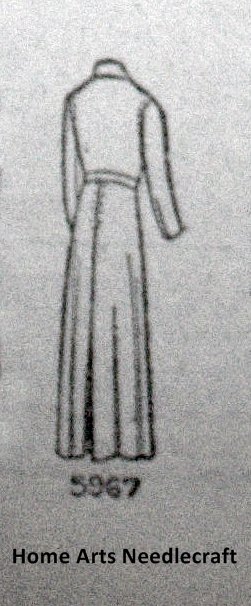 Most of these striped dresses are made very
simply, as any attempt at trimming such a garment at once detracts from its
elegance. Often the only embellishment
is the collar and cuffs of contrasting material, and sometimes an adornment of
fancy buttons.
Most of these striped dresses are made very
simply, as any attempt at trimming such a garment at once detracts from its
elegance. Often the only embellishment
is the collar and cuffs of contrasting material, and sometimes an adornment of
fancy buttons.
This idea is delightfully illustrated in design
No, 5967.
Here we have a pretty frock developed in
brown-and-white silk, with the attractive new-style collar, and the chic
turned-back cuffs of white silk, though brown may be used for this purpose if
desired.
The dress is made in the pretty Empire fashion,
and has the closing at the left side of the front. Brown buttons are used to trim the frock, the
fastening being accomplished with hooks and eyes underneath.
The new-style skirt is seen, and the entire
appearance of the garment is fashionable, and in the very best taste.
Blue-and-white silk, black-and-white serge or
voile, and any of the new striped serges and other woolen materials may be
used.
The pattern, No, 5967, is cut in sizes from 32 to
42 inches bust measure. To make the
frock in the medium size will require 6 ¾ yards of 36-inch material, with ½ yard
of 27-inch contrasting goods. Width of
lower edge is 2 ½ yards. Price of
pattern, 10 cents.
Wednesday, December 19, 2012
For Grown-up Girls and Little Ones
By Mrs. S.
J. Baldwine

Every little maid’s outfit should include at least
two of the washable hats of white pique, with button-on crown which can be
quickly and easily removed when laundering is needed. If nicely made, even with simplest
embroidery, these hats are quite pretty enough to be worn on special occasions,
and are certainly just the thing for every day, because the small wearer does
not need the caution, so often repeated” “Be careful of your hat, dear!” She knows and mamma knows that however mussed
or soiled it may become, a tubbing will make everything right again, and every
bit as good as new.
The hat may be entirely of white, with white
lining, or it may have a lining of light pink, blue, or any delicate color –
which must be, of course of washable material – with embroidery of the same
tint. The lining is put in after the embroidery
is done, and may be omitted, if preferred, since its real use is to conceal the
under side of the brim. By taking a
little care the embroidery may be made to look almost as well on the wrong side
as on the right, and while there is a decided difference in the two sides of
the fabric, the smooth or plain side is not objectionable.
Solid embroidery is preferred to eyelet,
especially if the hat is not to be lined; the designs illustrated are adapted
to either style of work, however. If
carried out in satin-stitch, as is the model, the padding should be heavy; and
if eyelet-embroidery is used care should be taken to keep the lines perfectly
true and even, and the eyelets, which are intended to be of the same size,
quite uniform. Any deviation from this
rule will be unpleasantly apparent.
Work the buttonholes as indicated, after
completing the embroidery and buttonholing of edges on both brim and crown, and
sew twelve pearl buttons of suitable size at corresponding intervals on the
brim. The hat may be readily adapted to
a larger or smaller head-size when cutting the opening of the brim, which
should be neatly hemmed or bound with bias tape.
These dainty bits of headgear are always
fashionable, the style changing little or not at all from season to season; and
the wise mother of small children who contemplates spending a few weeks or
months of the winter in Florida, or other “summer-the-year-around” resort, is
sure to have a supply of “button-on” hats ready for the little folks to wear.

While exquisite neatness of work is always a prime
essential in needlecraft, it seems particularly so in the fashioning of garments
for little folks. Because the embroidery
is simple, it should be all the more nicely executed, the lace edgings should
be fine and dainty, and the material light and sheer. French nainsook is frequently chosen, as is
lawn of fine quality, while mercerized batiste finds especial favor for “baby’s
best dress,” or even for the little gowns intended for more common wear, being
very soft and lustrous.
A pretty panel in eyelet-embroidery forms the
decoration of the wee dress pictured; if desired, the work may be continued to
the hem, but is very dainty and sufficiently elaborate as it is. The little sleeves are edged at the wrist
with Valenciennes, as is the neck, and every bit of the sewing is done by hand,
with fine thread and finest of stitches.
Take care always that there are no seams which will chafe a baby’s
tender skin; very often the sleeves are buttonholed in place, thus avoiding any
seam whatever around the little arms, save the very narrow and soft one
produced by the buttonholing.

The kimono or “slip-on” nightdress, cut in one
piece and with side seams only, is still the popular style. If a higher neck is wanted it may be filled
in with fine insertion and lace, and drawn up with narrow ribbons, the sleeves
being edged to correspond.
A very attractive though simple design for
embroidering such a garment is shown.
The lines are worked in stem-stitch; first padded by running with short
stitches, which are then whipped with padding-cotton; then with the
embroidery-cotton work over and over the padded line, taking up very little of
the material beneath so that when the work is completed the effect is that of a
small, smooth cord laid upon the goods and following the outline. The remainder of the work is also in padded
satin-stitch, save two of the little, four-petaled figures in each cluster;
these are outlined with the stem-stitch described and filled in with
seed-stitch, so much used in the real French embroidery. This stitch is taken after the manner of the
common back-stitch – a short stitch backward on the surface and a longer stitch
forward underneath; if a heavier “seed” is desired, take two stitches side by
side, the needle emerging and entering almost at the same place in both
stitches. All the four-petal forms may
be worked in this way, if liked, the result being much more delicate in
appearance.
The same design may be sued for a blouse –
omitting the initial – or a corset-cover; hence the transfer- or perforated
pattern will be found of advantage.
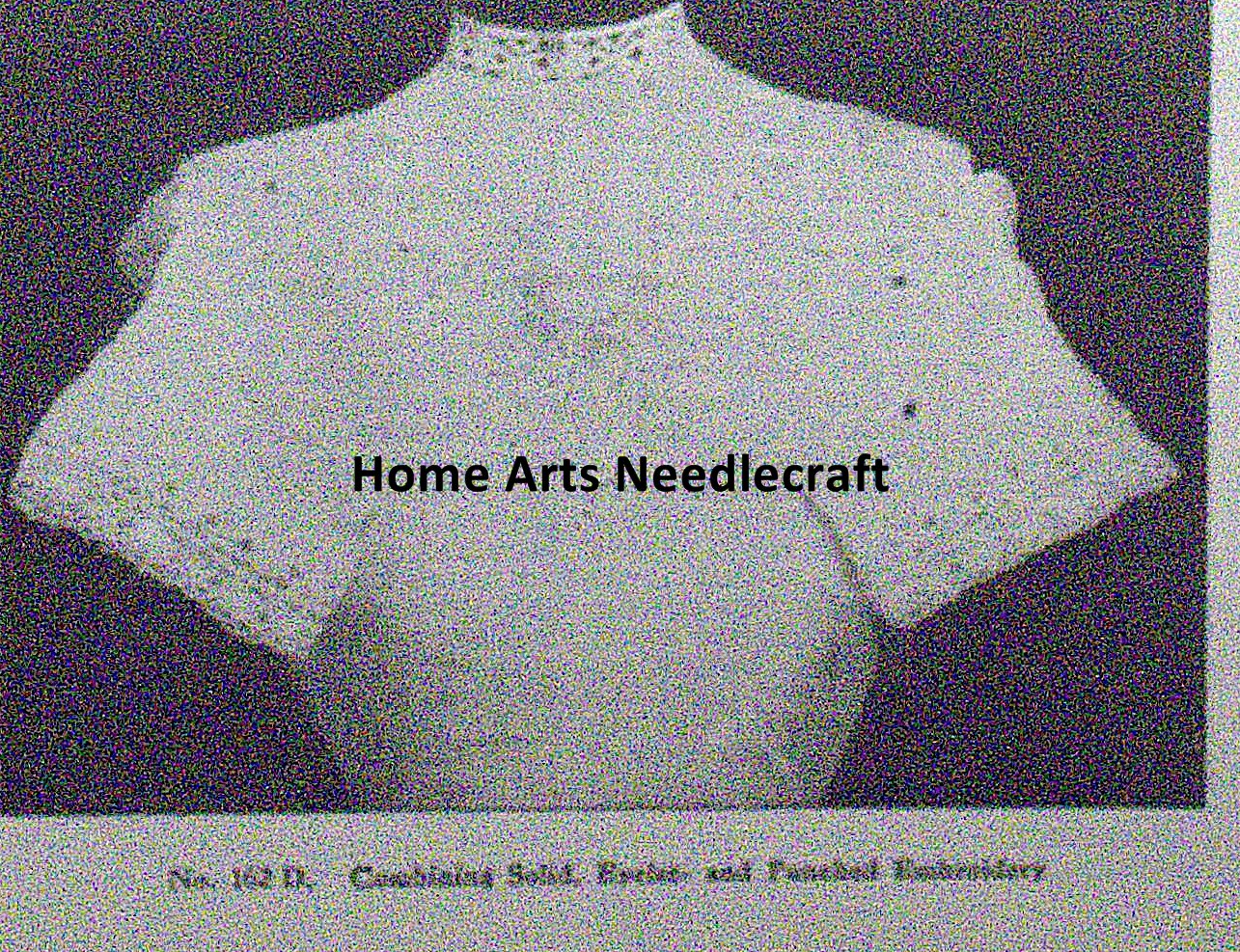
The girl or woman who feels the need of “just one
more” new and attractive waist to tide over the days of late summer and early
fall, its addition freshening an outfit which has begun to show a little wear
and tear, will appreciated the simple but very pleasing design in solid,
eyelet- and punched embroidery. Explicit
instructions for doing the latter have appeared; it consists merely in
separating or drawing apart the threads of the material, using a very large
needle, and binding them securely; in other words, a tiny square of the
material, say four or six threads, is surrounded by stitches, two in a place,
forming an opening on each side. The
work is easily done, even though not stamped expressly for the purpose; if,
however, the dots are stamped, it is a great help.
The embroidered band at the top of each sleeve
matches that of the waist, and may be applied to a collar, if desired. On the model a Cluny insertion, matching the
lace which edges the sleeves, is used for collarband, with pretty effect.
From present indications the present style of
blouses, so becoming and comfortable, will see no radical change, and on this
fact womankind is to be congratulated.
There are ultra styles which do not appeal to the woman of good sense,
and she does not adopt them; but when a garment has proven itself to be just
what she wants and needs, she is in no haste to let it go by.
No. 159 C.
Perforated stamping-pattern, 25 cents.
Transfer-pattern, 10 cents.
Stamped on pique, 25 cents.
No. 160 D.
Perforated stamping-pattern, 25 cents.
Transfer-pattern, 10 cents.
Stamped on nainsook, 60 cents.
No. 161 D.
Perforated stamping-pattern, 25 cents.
Transfer-pattern, 10 cents.
Stamped on English longcloth, $1.00.
No. 162 D.
Perforated stamping-pattern, 25 cents.
Transfer-pattern, 10 cents.
Stamped on punch-linen, $1.00.
Tuesday, December 11, 2012
Trio of Fascinating Costumes

November, 1912, Page 3
Handsome Charmeuse Frock

Another good point in its favor is the fact that it is serviceable, and the charmeuse gown may be used for every occasion from the most elaborate function to the informal street or house wear.
Model No. 5959, and No. 5963, represents a handsome costume carried out effectively in pearl-gray charmeuse with white lace trimming. Gray is one of the fashionable colors this season – in face, is one of the most fashionable, and the pretty frock shown will serve admirably for an afternoon or evening gown, or for the going-away dress of a bride.
There is a certain clever style about the costume which marks it as new and out of the ordinary. The waist has the lace draped in becoming fashion, while the collar and yoke of insertion and net is quite chic.
The new double frill is noted on the sleeves. In this costume the normal waist-line is defined with a belt of steel-gray velvet. This may be finished with a buckle of oxidized silver studded with emeralds, the light green contrasting beautifully with the demureness of the gray.
Perhaps the most characteristic touch is the draped skirt, in new panier fashion which represents the latest word in smart costuming. The waist-pattern, No. 5959, is cut in sizes from 32 to 42 inches bust measure. To make the waist in the medium size will require 5/8 of a yard of 36-inch chiffon, 2 yards of 36-inch material, 5/8 of a yard of 22-inch allover, and 2 ¾ yards of banding. If made of one material, 2 ¾ yards of 36-inch material is needed, with ¾ of a yard of 36-inch goods for the guimpe. Price of pattern, 10 cents.
The skirt-pattern, No. 5963, is cut in sizes from 22 to 30 inches waist measure. To make the skirt in the medium size will require 3 3/8 yards of 53-inch material. To make the skirt without the drapery, 2 5/8 yards of 54-inch material is needed. Width of lower edge is 2 3/8 yards. Price of pattern, 10 cents.
Elegant for Street Wear

This costume may be carried out effectively in dark-green cloth, or in any of the new shades of brown. It is a simple frock though a decidedly stylish one, and its construction offers no difficulty to the home-dressmaker.
The waist has the body and upper port of the sleeves cut in one, thus giving the drooping shoulder approved by fashion. The yoke is rather deep, and is of clever cut. It is outlined with a banding of velvet of a little deeper shade than the gown. The yoke and collar are of allover. The long sleeves have the latest-style cuffs, showing the double frill. The cuff itself is of allover, matching the yoke, and the frill is of wide edging. The waist closes at the back.
The skirt is a three-gored model, with double flounce, and it may be made with high or regulation waistline. The drawing shows the regular waistline which is defined with a belt of velvet corresponding with that outlining the yoke. The waist-pattern, No. 5987, is cut in sizes from 32 to 42 inches bust measure. To make the waist in the medium size will require 1 ¾ yards of 36-inch material, or 1 5/8 yards of goods 44 inches wide, with ½ yard of 22-inch allover. Price of pattern, 10 cents.
The skirt-pattern, No. 5981, is cut in sizes from
22 to 30 inches waist measure. To make
the skirt in the medium size will require 3 3/8 yards of 36-inch material, or 2
7/8 yards of goods 44 inches wide. Width
of lower edge is 2 yards. Price of
pattern, 10 cents.
Stylish Garment

The waist has the attractive Robespierre collar, and is further enhanced with a small vest which many of the smartest models for the present-season’s wear are showing. The long sleeves have plain deep cuffs.
The skirt is made with Empire waistline, and has
the new-style, cleverly cut closing-line.
It is perfect-fitting over the hips, hangs gracefully, and has the
necessary fullness and convenient width which the new skirt models call
for. It is effectively trimmed with a
group of large buttons.
This costume may be delightfully developed in
white serge or whipcord, both very fashionable for the coming winter. The bit of trimming on the waist is of black
satin, and the buttons on the skirt are either satin-covered or black bone. Quite a striking costume results.
Other appropriated materials include striped
serge, checked material, plain cloth, cashmere and Scotch mixture.The waist-pattern, No. 5969, is cut in sizes from 32 to 42 inches bust measure. To make the waist in the medium size will require 3 5/8 yards of 27-inch material, with 5/8 of a yard of 27-inch contrasting goods. Price of pattern, 10 cents.
The skirt-pattern, No. 5985, is cut in sizes from 22 to 30 inches waist measure. To make the skirt in the medium size will require 3 yards of 44-inch material. Width of lower edge is 2 yards. Price of pattern, 10 cents.
Friday, December 7, 2012
Showing the Latest Style Touches
1912, November, page 2
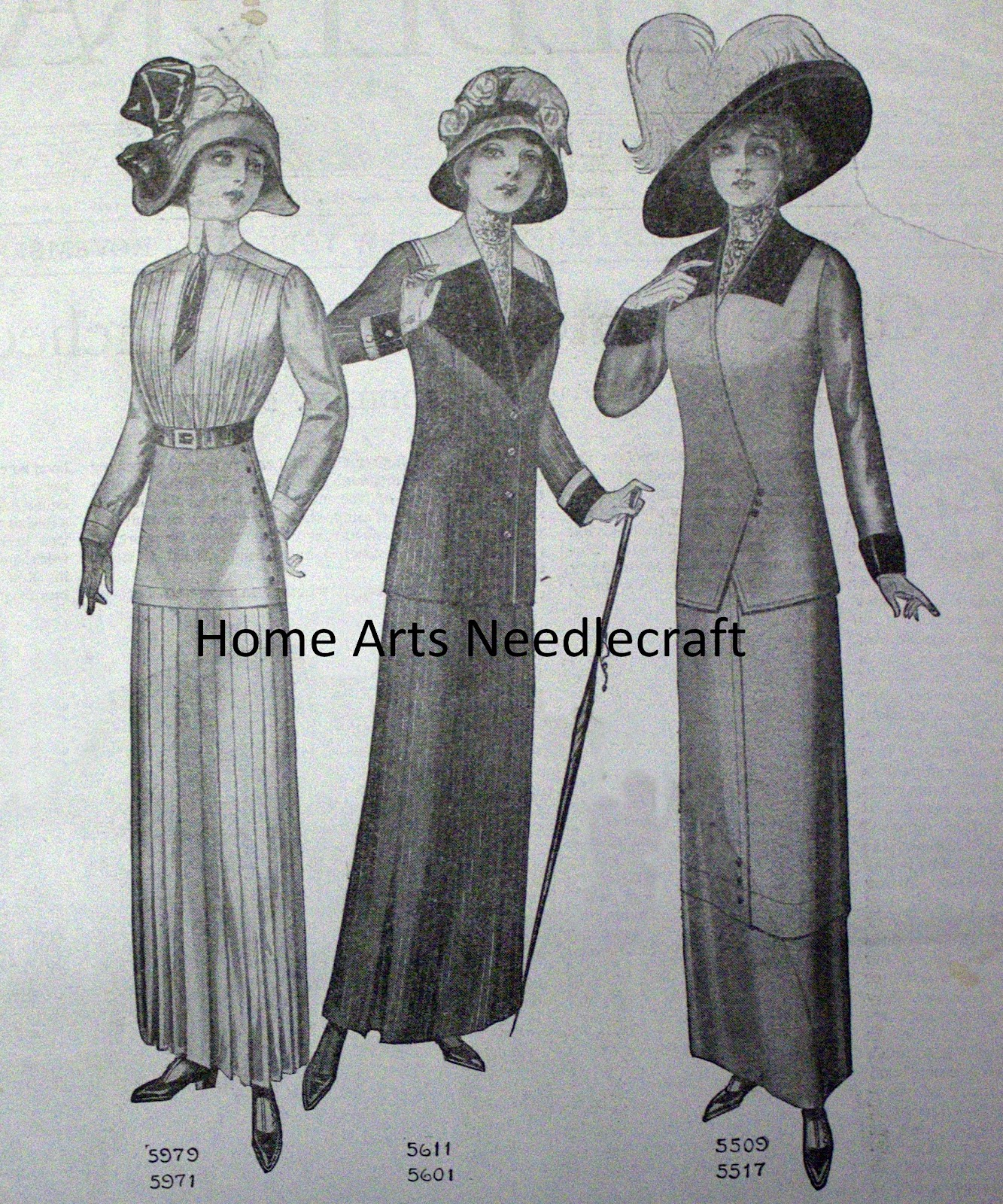
Ladies’ Shirtwaist Costume

The waist may be made with tucks or gathers at front, and choice of two styles of collar is given. The long sleeves have a chic cuff. The waist fastens invisibly under the center box plait.
The skirt is a one-piece plaited model, with straight lower edge. It may be fashioned with Empire or regulation waistline, and with or without yokes.
The clever style of this costume will appeal to the woman of good taste, and the ease with which it may be constructed will be another point in the garment’s favor.
Serge is a practical material for development, though mohair and taffeta will serve very nicely in carrying out the model.
The waist-pattern, No. 5979, is cut in sizes from 32 to 42 inches bust measure. To make the waist in the medium size will require 3 ½ yards of 27-inch material, 2 ½ yards of goods 36 inches wide, or 1 7/8 yards of 44-inch fabric. Price of pattern, 10 cents.
The skirt-pattern, No. 5971, is cut in sizes from 22 to 30 inches waist measure. To make the skirt in the medium size will require, with yokes, 4 ¾ yards of 36-inch material, 3 7/8 yards of 44-inch fabric, or 3 ½ yards of goods 54 inches wide, and without yokes, 5 ¼ yards of 36-inch material, 4 ½ yards of 44-inch fabric, or 4 yards of 54-inch goods. Width of lower edge is 3 ½ yards. Price of pattern, 10 cents.
Stylish Coat-Suit

Model No. 5611, and No. 5601, gives a design that fulfils all style requirements.
The coat is made in the newest fashion. It is 28 inches long; and its chief feature is the sectional collar, which is formed of two materials, adding much to the garment’s clever appearance.
The skirt is cut in eight gores, and has the closing at the left side of the back.
Blue-and-white rough-surfaced woolen was selected for the development of this chic model. The collar is of white rough-surfaced cloth and blue panne velvet. The cuffs are similarly treated. The coat fastens with four dark-blue bone buttons.
The coat-pattern, No. 5611, is cut in sizes from 32 t0 42 inches bust measure. To make the coat in the medium size will require 3 ¾ yards of 36-inch material, 2 3/4 yards of 44-inch fabric, or 2 ¼ yards of goods 54 inches wide. Price of pattern, 10 cents.
The skirt-pattern, No, 5601, is cut in sizes from 22 to 30 inches waist measure. To make the skirt in the medium size will require 5 yards of 36-inch material or 3 5/6 yards of goods 50 inches wide. Width of lower edge is 3 ¼ yards. Price of pattern, 10 cents.
A Clever Suit-Model

The closing line is quite chic, and is one of the fashionable details of the garment. The sleeves are finished with deep turned-back cuffs.
The skirt is a five-gored model, made with flounce, and with the closing at the front.
Any of the new and popular suiting-materials may be employed in carrying out the mode, with the collar and cuffs of satin, moire, or velvet.
The coat-pattern, No. 5509, is cut in sizes from 32 to 42 inches bust measure. To make the coat in the medium size will require 3 5/8 yards of 36-inch material, or 2 ¾ yards of goods 50 inches wide. Price of pattern, 10 cents.
The skirt-pattern, No. 5517, is cut in sizes from 22 to 30 inches waist measure. To make the skirt in the medium size will require 3 5/8 yards of 36-inch material, or 2 3/8 yards of 50-inch goods. Width of lower edge is 2 ½ yards. Price of pattern, 10 cents.
Subscribe to:
Posts (Atom)