Welcome to my blog about Home Arts Needlecraft Magazine! I "discovered" this publication about 2 years ago and fell in love with it to the extent that I had to start collecting issues as I ran across them. The magazine began publication with its September, 1909 premier issue, and continued through March, 1941. It has been interesting to follow the changes through the 30 plus years the magazine was published. It is a great source for needlework, fashion, recipes and short stories. Through my journey of sharing my issues online, I hope to discover a pattern of what was popular in different forms of needlecraft over the 3 decades. I hope you enjoy my blog as much as I am (so far!) enjoying posting articles and projects from the issues. Thanks for visiting!

Tuesday, December 11, 2012

Trio of Fascinating Costumes


November, 1912, Page 3

Handsome Charmeuse Frock
From authoritative fashion sources we have the information that nothing for dressy wear during the coming winter will take the place of the charmeuse frock.  This material is so soft and clinging and shimmering that it fulfils every requirement as a fashionable fabric when the new-style garments are considered.  Nothing drapes so readily; no material lends itself so admirably to so many purposes. 

Another good point in its favor is the fact that it is serviceable, and the charmeuse gown may be used for every occasion from the most elaborate function to the informal street or house wear.
Model No. 5959, and No. 5963, represents a handsome costume carried out effectively in pearl-gray charmeuse with white lace trimming.  Gray is one of the fashionable colors this season – in face, is one of the most fashionable, and the pretty frock shown will serve admirably for an afternoon or evening gown, or for the going-away dress of a bride.

There is a certain clever style about the costume which marks it as new and out of the ordinary.  The waist has the lace draped in becoming fashion, while the collar and yoke of insertion and net is quite chic.

The new double frill is noted on the sleeves.  In this costume the normal waist-line is defined with a belt of steel-gray velvet.  This may be finished with a buckle of oxidized silver studded with emeralds, the light green contrasting beautifully with the demureness of the gray.

Perhaps the most characteristic touch is the draped skirt, in new panier fashion which represents the latest word in smart costuming.  The waist-pattern, No. 5959, is cut in sizes from 32 to 42 inches bust measure.  To make the waist in the medium size will require 5/8 of a yard of 36-inch chiffon, 2 yards of 36-inch material, 5/8 of a yard of 22-inch allover, and 2 ¾ yards of banding.  If made of one material, 2 ¾ yards of 36-inch material is needed, with ¾ of a yard of 36-inch goods for the guimpe.  Price of pattern, 10 cents.

The skirt-pattern, No. 5963, is cut in sizes from 22 to 30 inches waist measure.  To make the skirt in the medium size will require 3 3/8 yards of 53-inch material.  To make the skirt without the drapery, 2 5/8 yards of 54-inch material is needed.  Width of lower edge is 2 3/8 yards.  Price of pattern, 10 cents. 
 
Elegant for Street Wear
Design No. 5987, and No. 5981, shows a splendid model for an up-to-date street frock.
This costume may be carried out effectively in dark-green cloth, or in any of the new shades of brown.  It is a simple frock though a decidedly stylish one, and its construction offers no difficulty to the home-dressmaker.

The waist has the body and upper port of the sleeves cut in one, thus giving the drooping shoulder approved by fashion.  The yoke is rather deep, and is of clever cut.  It is outlined with a banding of velvet of a little deeper shade than the gown.  The yoke and collar are of allover.  The long sleeves have the latest-style cuffs, showing the double frill.  The cuff itself is of allover, matching the yoke, and the frill is of wide edging.  The waist closes at the back.

The skirt is a three-gored model, with double flounce, and it may be made with high or regulation waistline.  The drawing shows the regular waistline which is defined with a belt of velvet corresponding with that outlining the yoke.  The waist-pattern, No. 5987, is cut in sizes from 32 to 42 inches bust measure.  To make the waist in the medium size will require 1 ¾ yards of 36-inch material, or 1 5/8 yards of goods 44 inches wide, with ½ yard of 22-inch allover.  Price of pattern, 10 cents.
The skirt-pattern, No. 5981, is cut in sizes from 22 to 30 inches waist measure.  To make the skirt in the medium size will require 3 3/8 yards of 36-inch material, or 2 7/8 yards of goods 44 inches wide.  Width of lower edge is 2 yards.  Price of pattern, 10 cents. 

Stylish Garment
Many clever style features are given in the attractive garment shown in design No. 5969, and No. 5985.  Here we have a serviceable street frock, quite easy to fashion, yet representing the very best style.

The waist has the attractive Robespierre collar, and is further enhanced with a small vest which many of the smartest models for the present-season’s wear are showing.  The long sleeves have plain deep cuffs.
The skirt is made with Empire waistline, and has the new-style, cleverly cut closing-line.  It is perfect-fitting over the hips, hangs gracefully, and has the necessary fullness and convenient width which the new skirt models call for.  It is effectively trimmed with a group of large buttons.
This costume may be delightfully developed in white serge or whipcord, both very fashionable for the coming winter.  The bit of trimming on the waist is of black satin, and the buttons on the skirt are either satin-covered or black bone.  Quite a striking costume results.
Other appropriated materials include striped serge, checked material, plain cloth, cashmere and Scotch mixture.
    
The waist-pattern, No. 5969, is cut in sizes from 32 to 42 inches bust measure.  To make the waist in the medium size will require 3 5/8 yards of 27-inch material, with 5/8 of a yard of 27-inch contrasting goods.  Price of pattern, 10 cents.
    
The skirt-pattern, No. 5985, is cut in sizes from 22 to 30 inches waist measure.  To make the skirt in the medium size will require 3 yards of 44-inch material.  Width of lower edge is 2 yards.  Price of pattern, 10 cents.

Monday, December 10, 2012

Fashion Review

1912, November, page 2
There is one very noticeable feature about the styles of the present day – their infinite variety, various indeed as the moods of a woman.  No two women need dress alike.  Every woman is a type, and each develops her own personality in dress.  Nearly all adhere to the general style-tendencies, but individuality in the matter of apparel seems more marked from month to month.
There has never been such a variety of materials and colors as this year.  There is a reversible peau de soie, one side dull and the other satiny, out of which some very successful tailored costumes are made.
The new French moire is as soft as the finest satin, and is used extensively for long cloaks both for day and evening wear.  In fact, the most remarkable feature about the materials this year is their extreme suppleness.
A fabric which has the advantage of being as easily washed as lawn, is a kind of silk tissue very closely woven, in cream shade sewn with small bouquets woven in the stuff.  This fabric, however, is not as soft as the other silks this season.
As for Shantungs they are to be seen in every variety of flower-designs, and with small scattered bouquets of flowers.  Then there is the Japanese silk which is very light, and soft, and slightly transparent, the only thing Japanese about it being its name.  It seems to have something of the character of silk voile and of satin.  This material is striped on the bias in such colors as sky-blue and black, line-green and black, or again there is a wide band of printed flowers along the bottom of the material.
Among the most successful in the silk damask and brocaded dress-goods for the coming winter, those having a taffeta foundation are quite important.  White striped black taffeta chiffon is represented in very large ranges, the foundation being usually sprinkled with small dots and trefoils or stars.  Grenadine damasks have the white stripes placed about two inches apart, and the small figures made in a soft satin weave.
Many lines show the combination of damask and brocade weaves.  Important among these is a pale-brown taffeta foundation with delicate, corded stripes, placed about an inch apart.  Small blue square brocaded figures are repeated at intervals of eight inches between the stripes.  Again there is a dark-blue, plain Duchesse foundation with widely scattered pairs of flowers, having gold contours.  One of the flowers is in the color of the foundation, while the other is in pale blue.  These pairs of flowers are placed diagonally, but far apart.
A dark taffeta foundation with wide marbled stripes contains various diamond and crystal shapes, executed in damask.  A navy-and-white striped foundation has brocaded rings having stems, each placed over two stripes appearing in alternate colors.  Rosettes composed of brocaded dark and pale-blue half moons appear over a changeable blue-and-gold foundation, while many among the latest lines show damask effects produced by gold and silver threads interwoven with mousseline foundation.
Among the novelty shades of this year are a new Persian blue, something like the Gobelin blue, which has also been selected this season as a novelty shade for trimmings; a leather-brown, a reddish violet, a light taupe, a cherry coral, and chartreuse-green.
Such shades as seal-brown and nut-brown are considered very good for the suitings for fall, with champagne as a third.  Eggplant-purple and very dark heliotrope are the purple representations for this fall.  A linden-green is shown in novelty dress-goods, while the wild-thyme-green and dark reseda are the greens selected for street suits.  Taupe, which is the French for moleskin, and the color of the fur, dark and light, for street- or for reception-wear, is a very good color, and there is a silver-gray which is very good, and a new blue-gray lynx, another fur color.
Every season there are new fashions in colors and color-combinations, just as there are new styles in the cut and make of the garments.  One of the most popular combinations of the fall is the navy-blue serge suit with the piping or trimming of chartreuse-green.  Blue and green, carefully used in shades that balance each other, make a very effective combination for the new season.
Speaking of green reminds one that a popular idea is the use of bright-green collars on suits of dark blue, of black, of black and white, of gray, of dark green in the same tones, and even on the reddish mixtures.  It is sometimes used even when there are trimmings of another shade.
Leather-color is another trimming color that combines with a variety of shades.  It is suitable for trimming dark blue, black and white, green and dark browns and wood-shades.  The Persian blue, and king’s blue are especially good as trimming for taupe material.  The cherry-coral and Roman red very sparingly used, may combine with taupe or dark mixture.
In a general way the colors and color combination for women’s tailored suits for fall and winter are mannish.  The tendency in suitings is toward darker colors, and mixtures of the sort that have been used for men’s tailored suits.  The trimming colors, like the styles in trimming, are kept within strict mannish limits.  There is, at the most, only a touch at the collars and cuffs or the vest, corresponding to the touch of color in a man’s necktie.  The vest may add a touch of color to match collar and cuffs, for it may be of white or leather color, or it may be flowered velvet and brocade in many colors.
Gray is to be one of the most prominent colors for the coming winter, and its more or less extensive use is shown in many of the smartest models so far shown.  Sometimes it appears only a trimming or as an underlining of the garment, but it is seen everywhere.  The selection of gray is regarded by dressmakers as a very happy choice, as it blends to perfection with the staple colors, like black, dark navy, white and brown and – a prime consideration for the winter – it accords with every kind of fur.  Among the many shades of gray, the brilliant shade will be used chiefly for trimming, in binding or in some other similar capacity, while a dull-toned gray is used on dress-goods and silks for street costumes as well as for elaborate toilets.
Gray has been adopted by the millinery trade for winter hats, either for the shape itself or the trimming, or for both.  Other toilet accessories, like belts, bags and shoes and hosiery are also featured in gray leather, silk or other fabric.
With the short and narrow skirts still in vogue, the importance of smart footwear is increasing with the demand for a perfect match or harmony in every detail of the toilet.  The high-heeled, low-vamp French shoes of gray leather, velvet or satin seem to fill this want admirably.
Low shoe will be worn during the winter more than ever to satisfy the eye, and openwork or plain silk hosiery of the flimsiest texture will accompany them.  However this cobweblike silk hosiery is for nothing else but ornament, as another pair of flesh-colored silk hosiery of substantial thickness will be worn underneath.
Much variety is displayed in the long coats for winter.  Among the many models seen in a recent fashion display was a coat of gray striped zibeline, piped, trimmed and lined with leaf-green.  The garment was cut to contrast the striped material by making the upper part of the coat the lengthwise of the goods, and the lower part, as I to cross the skirt in a suit-effect, the crosswise of the material.  Velvet piped the long cutaway of the upper part, the broad revers and scallops of the cuffs and collar, which buttoned back of the shoulder-linen on each side over a group of plaits which extended to the waistline.
An aviation coat of heavy striped polo cloth had the buckles and buttons covered with chamois, the color of the coat.  A gray diagonal corduroy cloth was piped with black satin, and has a cape-collar of gray velvet to match.  The yoke back with long back panel turned up and buttoned over about eight inches above the hem.
A dark-blue ratine striped black, had collar and cuffs of the coat of the reverse or striped side of the double-faced ratine, black and white.  A coat of red-and-black velours, changeant striped, had deep scalloped collar and broad revers and cuffs of white ratine, edged with black braid, and enormous red-rimmed buttons with cloisonné centers in flower designs.
There is a wide choice of materials for tailored suits.  Serges are in the lead, and there is a strong tendency for the corded, ribbed and twill goods, such as Bedford cord, whipcord, diagonals, plain illuminated and two-toned.  Corduroys and velvet are other good considerations.  Striped goods are favorites, and mixtures that have the new illuminated and rough-surface effects.
The trimmings are those already referred to, such as the large use of twist stitching, heavy twist in contrasting colors, and embroidered points of the silk, also of chenille; pipings of velvet, satin or cord, or cloth, tailored braid for edging and binding; novelty velvets and brocades for vests, collars and cuffs, broadcloth in all fashionable shades, such as the tans and chartreuse-green; suede cloth that looks like leather; and a large use of artificial fur or fur cloth is indicated.  Buttons in bold, simple styles, large-sized and medium, in celluloid, ivory, crystal and crochet continue to be important trimming-features.  Crustal buttons are very strong; also buckles are used and mannish belts.
Bright-color contrasts provided by means of sash or girdle, are noted on many of the new dresses.  And, for example, a beautiful white charmeuse draped with a short tunic of needle-run lace has the corsage also draped with the lace forming a fichu, and then tucked away beneath a wide belt of emerald-green satin.  The two ends of the belt are gathered slightly at the back, and are carried almost to the hem of the skirt, though they are looped up in the modish manner at about the line of the knees.
It must be noted in passing that a subtle shade of gray tints the white lace; and this shade, though so subtle, is important; for it gives a softness to the effect of the draperies that otherwise might be hard.
There are some very charming models designed in black or dark-blue charmeuse or taffeta.  A black charmeuse is designed with a quaint bodice embroidered at the edges with ruby red silk.  Inch-wide braids of the same silk fall from the shoulders in front to below the waist, where a narrow band of black varnished leather holds in the folds of the corsage.
At the back there is a shawl-collar of the charmeuse, worked in the ruby silk; and the basque which is short in front, is longer at the back, and is cut in one with the corsage only two or three rows of gauging marking the waist.
A tunic of black crepe chiffon falls in straight folds below the basque, and the under dress is also perfectly straight and narrow.  The corsage is charmingly finished with a vest of finely tucked net, decorated by a single frill, and fastened with berry buttons in ruby red.  A dress of this type is equally attractive if designed entirely in black.  It may or may not be granted the relief of a white chemisette, or the pretty contrast of a touch of green, in the berry buttons, which, by the way, should be of crystal so that they may reflect the light.
Many black-satin dresses are seen, and there is a wide scope for ingenuity to obtain a distinctive touch.  The neck can be finished with hemstitched lawn or with tulle, while a belt of red or king’s blue is very chic worn with these toilettes.
These belts are no longer tied at the side, but in a new style which consists of one long, wide end, which is fringed, passing around to the back, where from the center it falls low on the skirt.
A black taffeta dress with the skirt buttoned in front, had a draped corsage of white tulle, with a narrow border of zibeline.  A new idea in the present rage for embroidery was seen in a skirt of blue plaited voile, which had a deep band of ruby embroidery around the hips; the same embroidery appeared around the end of the short sleeves.
In the draped-effect a novelty is the holding in place of the drapery my means of a cord with tassels.  This was seen in a costume of blue cloth; the jacket in satin of the same color was fastened in the center-front with one button, and was trimmed with silver-gauze epaulets.
A jabot was used to finish the front of the coat, which is not cutaway, a black-velvet butterfly fastening the lace at the neck.
The style of veiling the hat in tulle to match some detail of the toilet is popular.  A black robe with fuchsia piping was accompanied by a black hat with fuchsia tulle.
Among several models in blue charmeuse recently noted, was one, the skirt of which was narrowly plaited from the normal waistline to the bottom.  The waist was also made of the plaited charmeuse, and had a white-satin panel, about three inches wide, extending from the rounded neck to the bottom of the skirt.  This panel was buttonholed crosswise and was trimmed with white pearl buttons.  The neck had a colored embroidered collar, finished with a small lace jabot, Robespierre fashion, at the front.  The sleeves were long, and were finished at the bottom with lace frills.
A foulard panier gown was in old-blue, with an allover design in white lilies.  The waist was made with a round neck and V yoke of the net; the waist was plain in back, and slightly draped in front, with three-quarter-length sleeves, showing a band of plain blue satin, corresponding with the color of the ground of the foulard, around the bottom, below which short undersleeves of the net were seen.
At the slightly raised waistline here was a crushed girdle of the plain blue satin, finished with a crushed girdle of the plain blue satin, finished with a corded ornament of the same at one side-front.  The skirt was made with a panier drapery, reaching just below the hips, showing more fullness at the back than at the sides, and at the left side-front from the panier to the hem, was a narrow inset of the plain blue silk.  The foundation skirt of the foulard was caught together over this in two places, and decorated with blue-silk tassels.
Many delightful waist-models are being displayed.  A pretty example of transparency was a blouse of plain white muslin in little sets of pin tucks, with a plain space between, and a turnover collar and cuffs made up of ruffled rows of Valenciennes.  Under this were revealed bretelles of rose-pink satin and a double band of the same ribbon going around the bust, and finishing at the side in a large, flat plaque of pink satin and Valenciennes lace, with a ring of tiny pink roses in the heart of it.
Ecru lace composed another bewitching bodice, a dainty thing with a basque.  The blouse itself was made of ecru net with a pretty floral pattern of applique, and it was bordered all around by a scalloped insertion lace to match, the scallop only serving to edge the bolero from the waist.  This was high and in Empire style, and underneath the basque came a folded belt – encircling the ordinary waistline – of blue satin.
The note of sky-color was repeated in a flat vest of blue satin, cut out in heart-shape, with a neckless yoke of plain net.  Then came a pretty detail, the neck, vest and Empire beltline being indicated by a fine silk cord, in which violet and blue were charmingly intertwined, while the buttons down the front, which were of pale-blue satin, were crossed with the velvet cord.
A waist of white net has kimono sleeves.  The shoulders and sleeves are tucked, and down the center is a broad band of antique insertion, finished each side with a narrow band, which extends across the shoulders.  The front band extends beyond the waistline, and is trimmed with fringe.  On the sides is a short peplum of lace; and the normal waistline on the sides is defined with a narrow folded belt of lavender silk, while the round neck is piped with lavender silk.
Furs this winter will assume the soft and supple styles.  The popular enveloping lines in gowns have inspired furriers to make a wonderful triumph in furs, so that a chic woman can envelop herself in a fur warp that appears almost as soft as supple satin or mousseline.
Moleskin or taupe, is said to be the popular mode for long mantle coats, which are made of whole skins, and have the furs arranged in novel designs, and fashioned to drape the figure in a mantle of no weight but great warmth.
Black caracul and baby lamb, made in the softest of furs, and draped in long mantle-coats are among the new models for the winter.  These soft caracul coats have wide shawl-collars of fox or ermine, and are lined with soft brocade satin.
Ermine will be worn again, as well as sable and fox.  Short coats are coming into vogue again, but in fancy effects.  Russian blouses and Spanish jackets will be sued to some extent.
Long coats are made 52 and 56 inches in length, and are box and semifitting, with straight liens and side effects.  Many of the models are being trimmed with reversed and combination furs, and crochet buttons with single frogs are sued for fastening.
There is nothing especially new about the muff, except that passementeries and fringes are sued to trim them quite extensively – that is, in the short-hair skins, the long-haired furs are made into muffs, using the whole animal.
Very handsome fur boas three to four yards long are lined with soft silk in high color.  A fur is being used which when dyed, closely resembles the Fitch; and the raccoon, when dyed, cannot be told from elk, and is very popular.  Coony when electrified, takes the place of beaver or nutar.  American weasel is used extensively for trimming, substituted in many instances for ermine.  There is also a great demand for Persian lamb, and pony will be used to a large extent.
Tan shoes are quite the smartest thing this season – they are leather-color, and not the red brown, which was fashionable last year.  With these shoes, stockings of all colors are worn, even green, blue and violet.
A novelty in neckwear is the Dauphin collar.  This is generally made in fine lawn, and is flat with broad embroidered revers, and is edged with lace.  It is worn without a high collar.
As a result of the present fancy for low-cut gowns, the ordinary one-sided jabot effect is not cultivated as it was, and two new forms of ruffle have made their appearance very daintily.
The first is meant for wearing with a gown that is collarless and fairly low, but not open in front.  It is of delicate Paris tinted lace, plaited, as a rule, in three fans of graduated length, and sometimes, instead of lace, the fall is of finely embroidered lawn.  There is no neckband visible, but a plain band of lawn goes around the neck under the yoke of the dress, and fixes the fall in place.
The second of these novelties shows a sailor-collar of black satin, with softly draped revers of fine creamy ecru net, and lace, which leaves the throat open in that long V which is so attractive.
There is another new jabot which traverses the length of the corsage, and descends to the skirt, the result being both novel and attractive.  A model was displayed made in the following manner: the skirt and vest of taffeta, the skirt high-waisted, the tulle blouse closing in front, with a soft jabot, which falls over the bust, and extends along the side of the skirt to the height of the knee, thus following the line of the fastening.
Soutache or silk-cord trimming is to be used in profusion during the present season on afternoon and evening gowns.  We shall see it allied not only to cloth and velvet, but to satin and chiffon as well.
It is generally noticed that where buttons play an important part, soutache closely follows, and such will be the case this season.  On evening gowns this trimming will take the form of flowers as well as scroll designs, and the Grecian-key pattern will adorn even the lightest and flimsiest of materials worked with this silk cording.
    
Gold-color on white is a favorite combination for evening wear, but self-colored soutache will be more used than contrasting shades.  It will also be in evidence on lace and silk blouses, in motifs, buttonholes, loops, etc.; in fact, it is safe to say that as a general trimming it will be in the first ranks of popularity.
Enameled “pomanders” are quite the rage among the toilet-accessories, and these tiny balls may be seen dangling from milady’s neck-chain or bracelet.
The top unscrews, disclosing a minute sponge on which to drop your favorite perfume.  This perfume gives off an agreeably faint odor through the little holes pierced in the trinket.  The pomanders are enameled on sterling silver, in pale blue, Nile green, lavender, and other pretty colors.
There are signs on the horizon that jet will be extremely popular during the ensuing months.  Large jet brooches are seen alighting on chemisettes of filmy materials, and the long chains of jet beads are making a bid for popular favor.  Then there is nothing that enhances the whiteness of the neck more than a collar of flat jet beads with a medallion in the center, of imitation jewels.
An interesting point about the new corsets, is the fact that we are returning to the curved side pieces instead of the straight, and the latest models are all showing this feature.  The straight side corset is losing its prestige with the corsetiere, so that the line of the hips will be more accentuated in future.

Friday, December 7, 2012

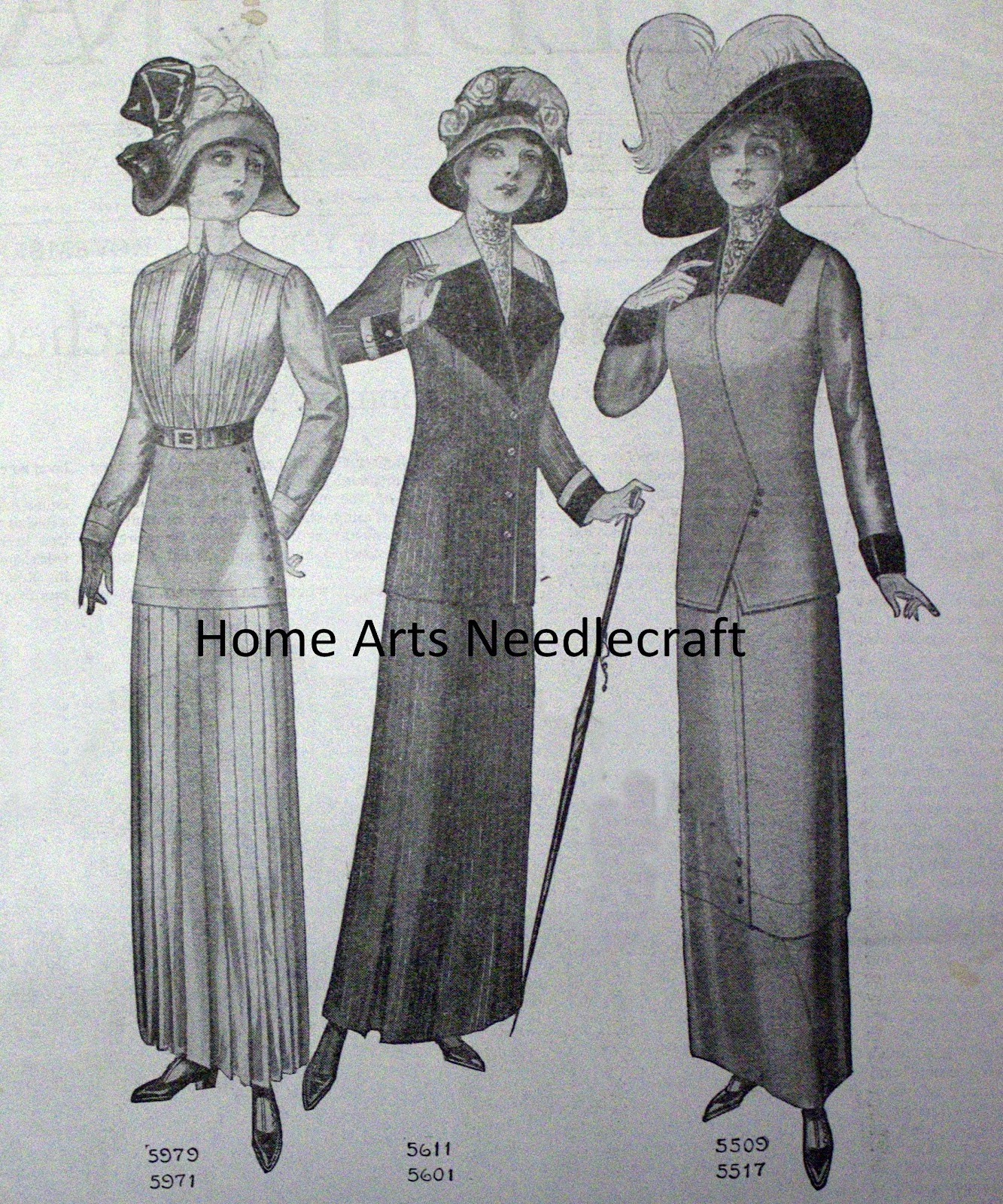
Showing the Latest Style Touches


1912, November, page 2
 
Ladies’ Shirtwaist Costume
     Model No. 5979 and No. 5971 shows a splendid costume in the nature of a shirtwaist dress, which is just the thing for general wear.
     The waist may be made with tucks or gathers at front, and choice of two styles of collar is given.  The long sleeves have a chic cuff.  The waist fastens invisibly under the center box plait.
     The skirt is a one-piece plaited model, with straight lower edge.  It may be fashioned with Empire or regulation waistline, and with or without yokes.
     The clever style of this costume will appeal to the woman of good taste, and the ease with which it may be constructed will be another point in the garment’s favor.
      Serge is a practical material for development, though mohair and taffeta will serve very nicely in carrying out the model.
      The waist-pattern, No. 5979, is cut in sizes from 32 to 42 inches bust measure.  To make the waist in the medium size will require 3 ½ yards of 27-inch material, 2 ½ yards of goods 36 inches wide, or 1 7/8 yards of 44-inch fabric.  Price of pattern, 10 cents.
     The skirt-pattern, No. 5971, is cut in sizes from 22 to 30 inches waist measure.  To make the skirt in the medium size will require, with yokes, 4 ¾ yards of 36-inch material, 3 7/8 yards of 44-inch fabric, or 3 ½ yards of goods 54 inches wide, and without yokes, 5 ¼ yards of 36-inch material, 4 ½ yards of 44-inch fabric, or 4 yards of 54-inch goods.  Width of lower edge is 3 ½ yards.  Price of pattern, 10 cents. 

Stylish Coat-Suit
     The coats of the present season are distinctly different from those of last year.  Many details mark the new coats as original and smart, and the woman who wishes to keep dressed up to the standard of the very best fashion, will study these details before deciding upon her coat-suit for the fall and winter.
     Model No. 5611, and No. 5601, gives a design that fulfils all style requirements.
     The coat is made in the newest fashion.  It is 28 inches long; and its chief feature is the sectional collar, which is formed of two materials, adding much to the garment’s clever appearance.
     The skirt is cut in eight gores, and has the closing at the left side of the back.
     Blue-and-white rough-surfaced woolen was selected for the development of this chic model.  The collar is of white rough-surfaced cloth and blue panne velvet.  The cuffs are similarly treated.  The coat fastens with four dark-blue bone buttons.
     The coat-pattern, No. 5611, is cut in sizes from 32 t0 42 inches bust measure.  To make the coat in the medium size will require 3 ¾ yards of 36-inch material, 2 3/4 yards of 44-inch fabric, or 2 ¼ yards of goods 54 inches wide.  Price of pattern, 10 cents.
     The skirt-pattern, No, 5601, is cut in sizes from 22 to 30 inches waist measure.  To make the skirt in the medium size will require 5 yards of 36-inch material or 3 5/6 yards of goods 50 inches wide.  Width of lower edge is 3 ¼ yards.  Price of pattern, 10 cents.
 
A Clever Suit-Model
     The coat of the clever suit model offered in design No. 5509, and No. 5517 is 25 inches long, and is gored to the shoulders at front and back.  It has a fancy collar which is pointed at the back.
     The closing line is quite chic, and is one of the fashionable details of the garment.  The sleeves are finished with deep turned-back cuffs.
     The skirt is a five-gored model, made with flounce, and with the closing at the front.
     Any of the new and popular suiting-materials may be employed in carrying out the mode, with the collar and cuffs of satin, moire, or velvet.
    The coat-pattern, No. 5509, is cut in sizes from 32 to 42 inches bust measure.  To make the coat in the medium size will require 3 5/8 yards of 36-inch material, or 2 ¾ yards of goods 50 inches wide.  Price of pattern, 10 cents.
 
    The skirt-pattern, No. 5517, is cut in sizes from 22 to 30 inches waist measure.  To make the skirt in the medium size will require 3 5/8 yards of 36-inch material, or 2 3/8 yards of 50-inch goods.  Width of lower edge is 2 ½ yards.  Price of pattern, 10 cents.

Thursday, December 6, 2012

A Grape Centerpiece in Punched-Embroidery

By Addie M. Bodwell
November 1912, page 1
 
Every housekeeper will appreciate the beautiful centerpiece presented herewith.  Certainly nothing could be handsomer for placing under a big bowl of fruit, on the Thanksgiving dining-table; and we all enjoy making something new and particularly attractive in time for the November holiday.  At first glance, because of its elaborate appearance, it would seem that a great deal of work is necessary to bring the piece to completion; but this is not so.  The design in one that produces a maximum effect with a minimum of time and labor, and one will be surprised no less than pleased to see how rapidly it may be executed.  A few minutes now and then, as even a very busy woman finds time to catch up her work for a “stitch or tow,” very soon show most encouraging results.  It is really wonderful how much may be accomplished in the way of decorative needlework if a piece is kept at hand, and spare moments employed on it – just as a bit of “play-time.”

The solid embroidery is first done, in well padded satin-stitch.  In working the grapes, as well as the leaves and oval forms, take care that the padding-stitches are laid in a contrary direction to those which cover them.  This is very essential, since if both sets of stitches cross in the same way, they are very apt to separate, when the piece is laundered, giving a rough, uneven appearance to the work, and showing the fabric beneath,  Take ___  padding-stitches next to  the stamped line, or within it, and let the covering stitches extend over or cover the line.  The latter must be very true, following the line exactly; a great deal of the beauty of any piece of work depends upon the careful observance of this rule.  Leaves or any form that is longer than wide, are padded lengthwise, the covering-stitches being taken across; circles have the padding stitches taken, as stated, in one direction, the covering-stitches crossing them at right angles.  In working grapes, too, it must be remembered that all the covering-stitches in a single cluster should run in the same direction.  Should each grape be worked regardless of its companions, the hot-or-miss effect produced will be far from pleasing.  It makes little difference whether the stitches are taken across or up and down – although most workers prefer to take them lengthwise of the cluster; but the rule that all should be alike is hard and fast.  Remember, too, that the padding should be done as carefully as the outer work; if the best results are expected one cannot afford to slight the foundation.

In working the leaves, whether in long-and-short- or satin-stitch – and one method is not less attractive than the other – care must be taken to keep the outline of the leaf perfect.  The veining is done in outline- or stem-stitch, and the stems invariably in the latter.  First run the lines intended for stems with short stitches, then whip this row with padding-cotton.  Work over and over the padded line in satin-stitch, taking up very little of the material; you will thus get the effect of a smooth cord, raised from the surface, and adding to the richness of your work, as an ordinary outline-stitch can never do.

Having completed the solid embroidery, and buttonholed the edge of the centerpiece, you are ready to commence the punched work, or background.  This has been so explicitly described that further details seem quite needless.  It is not at all difficult, the main question being just how to work around or fill in certain portions of a design which has many curves and irregular spaces; but this knowledge is something that comes to one as the work progresses.  The first instructions were for working first in one direction throughout, and then the other; but frequently, when surrounding a leaf or other form of irregular contour, it is better to finish as you go – that is, to work the tiny squares both ways; and many prefer to do this in all the work.  Punched-embroidery simply surrounds each tiny square of the material – four or six threads each way – wit stitches, one on each side, taken twice in the same place, and drawn tightly enough to keep the opening made by the large needle. 

Another problem which the beginner sometimes feels unable to solve is how best to fasten the working-thread.  It is needless to say that a knot should never be made, either when commencing or fastening off a thread.  To begin, use a sewing-needle, pushing the latter along under the embroidery to the point where the punched-work is to begin, and fastening with a close buttonhole-knot; finish in the same way.  When it is necessary to add a new thread, join the end to that of the thread you have been using, with a flat, firm knot, which may be drawn underneath as you work, and will not be visible.

If it is desired, the beautiful centerpiece illustrated – which, by the way, measures twenty inches – may be worked in colors, using purple or deep violet for the grapes and green for the leaves and stems.  The white work is very lovely, however and one is not apt to tire of it.  Having the design, too,, one may use it for a much larger centerpiece, alternating the motifs, or, if preferred, using the grape cluster with leaf each side for opposite sides of the piece, as in the model, and placing between them two of the clusters without leaves.  The ingenious woman, too, who enjoys “working out” designs for herself, giving them a touch of her own individuality, will be able to arrange the same motif as a scarf-end or border for a teatable-cover.  Have the motifs traced on small pieces of paper, and when they have been satisfactorily placed or arranged, use  impression-paper to transfer them to a square or circle of white paper of the desired  size; the entire design thus provided may be easily transferred to the material, and is ready for the needleworker.  A wise housekeeper, whose own home is overflowing with pretty and useful things, and who always has a bit of decorative needlework to share with a  friend, says that she always “takes off” the design of any stamped article which she purchases or receives for other source.  These designs she applies to different pieces, sometimes combining two or more of the same general character, or using but a portion of one or another, as may be required, with the result that her work has an individuality rarely found in the production of amateurs.  The study is a very fascinating one, too, and practice has made her so expert that, with no instruction whatever in free-hand drawing, she is able to provide an entire luncheon-set, or linens for dining-room or bedroom, from a single piece.

No. 151 D.  Transfer-pattern, 15 cents.  Perforated patterns, 30 cents.  Stamped on 24-inch heavy punch-linen, 50 cents.


Wednesday, December 5, 2012

Answered by the Editor

January 1912, Page 24

     I tried mixing red and blue paint together in order to get a purple for stenciling a grape-pattern, and the result was a muddy brown; yet my instructions tell me to mix those two colors.  Can you tell me what the trouble is?  I should also like to know how to mix the paints for roses, as I wish to stencil some curtains with a border of those flowers. ---F.B.W.
    There are reds, and reds, you know: crimson lake, with a very little Prussian blue should give you a good grape-purple.  You do not suggest the color you wish to use for the roses.  Crimson lake, lightened with a bit of silver white, makes a pretty rose-pink, a darker shade being produced by using the lake alone.  By adding a very little black to the latter you will get a dark red.  Why not try artists’ crayons for stenciling?  I am sure you will find them very satisfactory.
 
 
    I wish contributors would tell us just what number of thread to use to make a centerpiece or doily of certain size.  I would like to make a bedspread like the pattern of sash-curtain in crochet which appeared in the May, 1911, number.  What kind of thread would be best to use? ---Mrs. L.A.J.
    A contributor might tell you how large a doily resulted from using a certain size of thread, and your method of working might produce one much larger or smaller.  Two doilies were recently sent me for sale; they are of exactly the same pattern and the same thread was used, yet one of them is nearly twice the diameter of the other.  The work on one is unusually close and even, that on the other very loose.  For the bedspread one may use knitting-cotton, thread or – as you suggest – carpet-warp.  One of my correspondents writes of having made such a bedspread of No. 40 linen thread; she says it is very beautiful, and that she calls it her Needlecraft spread.  Try a small section of the pattern, using either material named, and you will easily decide which you like best.
 
 
    I have a tinted centerpiece which has become somewhat soiled while being worked.  As it is intended for a Christmas-gift I do not want to launder it.  Is there any way to cleanse it without the use of water or gasoline? ---Alla  F.
    I have known the following method to succeed admirably:  Take a t hick piece of wheat bread – a five-cent loaf from the baker’s will be just the thing, even if a little stale.  Slice off the end and rub the centerpiece with the soft, fresh-cut bread, going over the whole work.  As soon as the bread looks soiled, cut off another slice so that a clean, fresh surface will be presented, and repeat until you have thoroughly rubbed the piece and it seems clean; then shake and brush it well, lay it face down on a thick ironing-blanket, place a thin cloth, slightly dampened, over the back and press with a moderately hot iron.  Bread, used as indicated, is an excellent cleanser of soiled wall-paper.
 
 
    I have directions for a sweater which call for shell-stitch, in knitting, but do not describe it.  I wonder if Needlecraft can and will tell me how it is done? ---N.M.
    Needlecraft can and will try, surely.  The following is lemon-stitch not infrequently called shell-stitch”:   Having a number of stitches divisible by 4, knit 2, over, purl 2, and repeat to end, for 1st row; 2d row  - knit 2, purl 3; 3d row – knit 3, purl 2 – always repeating to the end; 4th row – like 2d; 5th row – slip 1, knit 2, pass the slipped stitch over the 2 knitted stitches, over, purl 2; repeat.  Repeat the pattern for 2d row.  For a wider shell put the thread over twice in center, in 1st row; returning, knit 3, purl 3, and continue as directed, save with the extra stitch, and at end of 5th row (having put thread over twice) purl 1, purl 2 together.  There is a shell pattern in knitting, very pleasing as a stripe for counterpane and other large articles, which requires 26 rows to complete and for a single pattern 38 stitches; and peacock- or fan-stitch is also sometimes called shell-stitch.  The latter requires a number of stitches divisible by 9, with 4 additional, and has 7 rows.  This shall be given you, if you wish, and if neither stitch is the one wanted I shall be glad to “try again!”
 
 
    A friend showed me a piece of work done in what she called the “new Turkish embroidery.”  It was a dresser-scarf, and she had a toilet-cushion, handkerchief-case and several other small articles done in the same stitch.  My friend said it is very easy to do, and rapidly worked, and certainly it is effective.  It looks to me like shadow-embroidery wrong side out.  Will you describe it? ---Louise Parker.
    You have already done so – it is “shadow-embroidery wrong side out, “ literally, and done in exactly the same way.  In shadow-embroidery the cross-stitches are at the back of the work showing through the sheer material; in Ismit or Turkish stitch – nothing more nor less than the old Janina stitch – the threads cross on the right side, and the tiny edge stitches are at the back.  I am glad you “love Needlecraft more and more every day” – Needlecraft reciprocates!  The prices charged for the embroidery sold were not exorbitant, but very reasonable, I should judge from your description.
 
 
    Can Needlecraft tell me how to mix paints so as to produce a real copper-color?  ---Miss D.F.
    Try twenty parts of white, four parts medium chrome yellow, one part raw umber and three parts Venetian red.  Your question in regard to “a good stenciling-outfit” will be perfectly answered by a “shopping-tour” through Needlecraft’s advertising columns.
    

    Will you kindly tell me how to make a hood of Angora yarn?  I should like to know where I may obtain a book giving directions for knitting and crocheting different articles of wool. ---W.S.B.

    A plain hood, either knitted or crocheted, may be made by starting at back of neck, working back and forth until you have a crown of the length desired, then around the latter, up one side, across top, down other side, turn, and continue working back and forth until the front portion is of the width required to cover that front of the head.  Add a turnover, if this is wanted, and a cape.  The following general directions for knitting such a hood may be followed in plain crochet:  Use bone needles, No. 5 or No. 6, and work loosely.  Cast on 26 stitches, knit across twice, then in next row widen a stitch and each end of needle.  Knit plain 56 rows, or length of crown, and at end of last row turn and pick up the stitches down the side, knitting a stitch to each ridge; turn, knit to top, across the top, down the other side, turn, and continue knitting back and forth for 50 rows, or until the front of hood is wide enough for the head.  Knit 20 rows or more additional for the turnover, and bind off.  Pick up the stitches around the neck for the cape, do 12 rows plain, then knit 30 rows, widening every 7rh stitch to give the circular shape or flare.  Bind off, and finish with a crocheted scallop.  This hood may be easily decreased in size or made larger, and is very neat and comfortable.  Send your full address for reply to your second questions.

Tuesday, December 4, 2012

What Other Needleworkers Found Out

January 1912, page 22

(Disclaimer - please use common sense if using some of these tips.  Remember - these are 100 years old!)
 This department is open to all our subscribers.  If you have made a discovery which proves helpful to you in plain sewing, embroidery or lacemaking, do not fail to send it to Needlecraft’s editor, in order that others may share the benefit.  For each of the three hints received during the month, and judged to be the most helpful, original, and practical, a crisp dollar bill will be awarded.
Very often we find dropped stitches in our knitted underwear; if these are neglected they will soon result in long rents.  They should be picked up at once with a fine steel crochet-hook, or, better still, a hook such as is used in knitting-mills, having a little tag or point which holds the loop while the next is being picked up.  Insert hook in stitch, draw the next through, exactly as in crocheting, and continue until all are picked up; then with a sewing-needle, take loop from hook and sew securely to the chain from which it dropped.  If more than one stitch has been dropped, repeat the process until all are brought up in like matter; then if there should be a large rent, insert needle at one end, take a small stitch at one side, then at the other, drawing close together, run the needle through and bring in both ends.  This is the method of darning used in the knitting-mills.   ---M. M. Barry.

How many of us have spent hours sorting out loose buttons from the collection in the button-box or –bag?  The question “Button, button, who’s got the button?”  I have solved very satisfactorily in the following manner:  Procure several sizes of safety-pins, and string each kind of button, putting the large ones on large pins, smaller ones on other sizes, as required.  The pins, fastened, may be kept in the box or bag, or may be fastened to a case made of heavy cloth, which may be rolled up to occupy small space, and unrolled when the selection of buttons is in order.  ---A New Needlecrafter.

Many find it difficult to put a band on a waist and get it to fit just right.  My plan is to leave the band until the last;  have the waist cut some longer than necessary, put on and tie down with a small  cord, push the gathers neatly into place and draw down to fit correctly.  Next, take a pencil and mark around the waist along the cord – or get some one to mark it for you – untie and you have a line to guide you in cutting.  Cut a little below the line, allowing enough for seam, gather, put on the band, and you have a perfect fit.  ---Esther Hutton.

When making sofa-pillow covers for everyday use, get plain, serviceable material – checked gingham serves nicely, also – trace some simple design upon it, thread your sewing-machine with some bright-colored thread and stitch the design several times, following the outline as closely as possible.  You will have a really pretty pillow-cover with the expenditure of little time or labor.  Stand-covers, dresser- or table-scarfs and other articles of household use may be treated in the same way.  We all like pretty things, even though we cannot spare much time for hand-work on them.  ---Mrs. T. David.

When making up nice dress-goods or any fancy material, do not throw away even the smallest scraps, but have a box or bag near your work-basket to save them in; you will find them convenient for many small articles.  The same is true of wash-goods, such as gingham, percale, and so on; very tiny pieces may be utilized in making quilts by selecting suitable patterns. ---Miss C. M. Kichline.

A hint for mothers:  When making baby’s skirts, have the yoke come about halfway on the armhole. Hollow a space in the body of the skirt, and put in two or three tucks; as the little one grows, let out the tucks to make the skirt fit.  This saves putting in new yokes.  ---Mrs. F. C.

I find that to use the old-fashioned chain- or lock-stitch as padding makes a buttonholed edge, or other raised work, look heavier and smoother than when ordinary padding-stitches are put in.  Work over it with satin-stitch, slightly slanting.     ---Mrs. R.M.R.

Use a sadiron, slightly heated, for smoothing out dress-patterns.  Lay pattern on fabric to be cut, smooth out, and mark perforations with colored crayon or pencil.  By this method you will not tear nor cut the thin paper, as a tracing-wheel is sure to do.  No pins will be needed, if care is taken.  For hem or facing, press with iron, and no basting is required; thus time and labor are saved. ---Alice Phillips.

To prevent buttonholes tearing out of knitted underwear, take the garments before they are worn and stitch around each buttonhole three or four times on the sewing-machine.  Try this, busy mothers, and see what a help it is.  ---Mrs. Florida Palsley.

Try this way to use up small pieces of woolen or fleeced goods, making a serviceable and pretty rug:  Cut your scraps into strips about two inches wide, and gather through the center, using the ruffler attachment on the sewing-machine; have plenty of dark colors mixed in well with the brighter ones.  Stitch closely on a firm foundation of shape and size wanted for the rug.  ---Clara Folsom.

When your “men-folks” get a safety-razor blade that is too dull to use as originally intended, do not throw it away, but use it to rip up garments or any seams.  There is nothing better.  ---Mrs. S.E.H.

When sewing on goods that ravel easily, try overcasting the sleeve and leaving this thread long enough for the gathering-thread.  It will prevent the goods raveling more, and also answer nicely for the first gathering, thus saving both time and work.  ---Mrs. H. H. Dickinson.

Most mothers know what a trouble it is to keep the little folks- underwear in place and pull a stocking up at the same time.  If a piece of tape is sewed on the bottom of the drawer-leg, so that it will come under the instep just as a gaiter-strap does, it will hold the drawers down smoothly.  The device is a real “mother’s helper,” too, for most children can put on their own stockings where it is used.  ---Mrs. E.A.C.

This is what I call an easy way of padding scallops:  Use spool darning-cotton and, if the scallop is very wide, use three strands, catching down at intervals and buttonholing over.  For a medium scallop use two strands, while a narrow scallop will require but one strand which can be carried along as you work.  Please try this.  ---R.C.F.

As the buttonholes in my little boy’s pants were always tearing out because of the strain, when buttoned to the waist, I tired sewing a piece of shoe- or corset-lacing (beginning at one end) firmly to the seam made by stitching the piece of cloth containing the buttonholes fast to the pants, running the lacing up and around the buttonhole, and back to the point where it started.  Fasten securely, cut off and work a buttonhole over the string and goods together with very fine thread – coarse thread makes the work too thick or bungling.  Since I began practicing this method twelve years ago, both on pants made at home and those purchased readymade, I have never had a buttonhole tear out.  ---Mrs. K.

I had a coat of the full-length Raglan style in vogue six or eight years ago.  This I carefully ripped apart, brushing thoroughly, gave it a bath of black dye and, after it was washed, dried and pressed, recut it by a Needlecraft pattern of new style, thirty-inch-length coat.  I followed Needlecraft’s lessons in coat-making, lined my coat throughout with black satine, made the collar and cuffs of black silk, partly worn, and now have a new and stylish garment at the small expense of twenty cents for die and patter.  I sincerely trust other needleworkers may do likewise; to the economical woman such a saving means a great deal.  ---Mrs. Howard Palmer.

When woolen skirts, suits, or men’s clothing require pressing, try using a mixture of three tablespoonfuls of coal-oil to a pint of hot water.  Dip a towel in the water, place it smoothly over the garment to be cleaned, and press with a hot iron until dry.  Remove the cloth and you will find stains, dust, etc., to have vanished.  Your garments will look as well as though they and been sent to a professional cleaner.  ---M.P.W.

************************************************************************************** 

When setting lace insertion in the skirt flounce or the yoke of a lingerie frock, where the lace must stand some strain, place strips of bobbinet or net under the lace.  All lace yokes, indeed, should have a net lining.  They are made much stronger, and their beauty is rather enhanced than lessened.

One of the newest things in jabots is the frill of maline, in which a plaited piece of the material about twelve inches long is caught together in the center with a strip of the same, and pinned at the collar, forming a semicircular or spreading, fan0shaped jabot.  Another, of marquisette, has the lower edges graduated by being cut obliquely, and is decorated with insertion and edging of narrow Valenciennes or Cluny lace, in which a touch of color is often introduced.

Monday, December 3, 2012

A Practical Centerpiece


By Mrs. S.A. Garlough
January, 1912, page 21

 Make a chain of 8 stitches, join.  Chain 1, 14 doubles in ring, join to 1 chain.
1. Chain 5, miss 1, a treble in next, *chain 2, miss 1, a treble in next, chain 2, a treble in same place, chain 2, miss 2, 1 treble, repeat from *, forming 9 spaces and joining last 2 chain to 3d of 5 chain.
2. A single in space, chain 5, a treble in same space, *chain 2, a treble in next space, chain 2, 2 trebles, separated by 2 chain in next, repeat around, joining to 3d of 5 chain.  The work should lie perfectly flat and smooth, and somewhat depends on the material worked with, as well as one’s method; some crochet very tightly, others loosely.

3. Chain 3, a treble in each stitch all around; join to top of 3 chain which represents 1st treble.

4. Chain 5, *miss 2, a treble between next 2 stitches, chain 2; repeat from * around, join to 3d of 5 chain.

5. Chain 5, *a treble in space, chain 2; repeat from *, widening as necessary to keep the work flat; join.

6. Chain 6, treble in space, chain 3; repeat around, join to 3d of 6 chain.

7. A single in space, chain 3, 2 trebles, 2 chain and 3 trebles in space, *chain 1, miss 1 space, shell of 3 trebles, 2 chain and 3 trebles in next; repeat from *around, chain 1, join to 3 chain at beginning of 1st shell.

8. Slip-stitch to center of shell, chain 3, 2 trebles, 3 chain and 2 trebles in shell, *fasten with 1 double between shells, shell of 3 trebles, 3 chain and 3 trebles, in next shell; repeat from * around, joining to top of 3 chain.

9. Make 14 trebles in shell, fasten in the fastening stitch of last row between shells; repeat around, joining in stitch where the row started.
     This row completes the smallest size of doily, or tumbler-doily, of which there may be as many as required, either six, eight or a dozen in the set.

10. Slip-stitch over 7 trebles of the scallop, chain 9, fasten between the 7th and 8th trebles of next scallop; repeat around, joining last chain where 1st started.

11. Same as 3d row.

12, 13, 14. Same as 4th, 5th and 6th rows, keeping the work flat and smooth.

15, 16, 17. Same as 7th, 8th and 9th rows, using double trebles (over twice) instead of trebles, if preferred, to make the shells and scallops a trifle larger than in the small doily.
     The second size of doily, for bread-and-butter plates, bowls, etc., is finished with the 17th row.  Repeat from 10th to 17th rows inclusive for yet another size.  As will be noted, as many sizes may be made as desired in this manner; then for the centerpiece these rows may be repeated to give the requisite size before the border is added, as follows:

For the border:
1. Having repeated the 3d row of plain trebles, chain 4, *miss 1, a treble in next, chain 1, repeat around; join to 3d of 4 chain. 

2. Same as 3d row.

3. Chain 5, a treble in same stitch where chain started, *(chain 1, miss 1, a treble in next) 7 times, chain 2, a treble in same stitch with last treble; repeat from * around, joining last 1 chain to 3d of 5 chain.

4. A single under 2 chain, chain 3, a treble in same place, chain 2, 2 trebles under same chain, * chain 1, miss 1st space, (a treble in next space, chain 1) 5 times, chain 1, shell of 2 trebles, 2 chain and 2 trebles under 2 chain between 2 trebles following repeat from * around, joining last 1 chain to top of 3 chain.

5. slip-stitch to center of shell, chain 3, 2 trebles, chain 3, 3 trebles, all in same shell, * chain 6, miss 3 spaces, a treble in treble, chain 6, shell in next shell; repeat around, joining last 6 chain to top of 3 chain.

6. Slip-stitch to center of shell, chain 5, 7 trebles in shell, chain 2, 1 treble in same shell, * chain 3, fasten in top of treble with 1 double, chain 3, a treble in next shell, chain 2, 7 trebles in same shell, chain 2, 1 treble in same shell; repeat from * around, joining last 3 chain to 3d of 5 chain.

7. A single under 2 chain, chain 5, *(a treble between 2 trebles, chain 2) 6 times, chain 2, a treble under 2 chain, chain 2, a double in double, chain 2, a treble under 2 chain, chain 2, repeat from *, joining last 2 chain to 3d of 5 chain.

8. A single under 2 chain, chain 6, (a treble under next 2 chain, chain 3) 5 times, a treble under next chain, chain 2, a double in double, chain 2, a treble in 1st space of scallop, chain 3; repeat around, joining last 2 chain to 3d of 6 chain.

9. (A double under 3 chain, chain 5) 6 times, a double in double between scallops, chain 5; repeat around, joining last 5 chain where 1st started.
     The border, although simple, is very attractive and may be added to a linen center.  A very pretty set consists of one large centerpiece, two smaller ones, and three sizes of doilies.  If it is desired to make oval mats to match, for platters and similar dishes, commence with a chain in the center, working around it with doubles and widening at the ends; then, when making the spaces, do the widening also at each end and at the sides close to the ends, having plain spaces along the sides between.  An oval doily or centerpiece of any required size may thus be easily made.
     After the same pattern or directions, one may fashion a very pretty bureau-set.  Using pink, blue, pale-green, or any delicate tint corresponding to the general color-scheme of your apartment, make the shells and scallops of this, with the rows of plain trebles, spaces, etc., of cream-white.  Or, if preferred, the shaded mercerized cotton may be used, yellow, violet, pink, blue, green, or any desired color, with white; or the pieces may be of white, thus harmonizing with any fittings.  For the bureau or dresser an oval mat will be needed for the brush-and-comb tray, with two smaller ones for the toilet-bottles, and a cover for the cushion 9either round or oval) to match.  A similar set may be made for the commode.